Tag: ROAD TRIP

  • Mumbai to Hyderabad Road Trip in a 7.5-Year-Old Tata Tigor

    Mumbai to Hyderabad Road Trip in a 7.5-Year-Old Tata Tigor

    Long-distance highway driving in India is usually discussed at two extremes. On one end, you have glossy road-trip narratives built around new cars, wide highways, and ideal conditions. On the other, you have anxious forum posts questioning whether a particular car is “capable” of doing a long drive at all. Real-world ownership lives somewhere in between, as I discovered in this Mumbai to Hyderabad road trip.

    Introduction: Why this drive deserved to be written about

    This Mumbai to Hyderabad road trip was done in a 7.5-year-old Tata Tigor during peak holiday season, with real traffic, real fatigue, and no attempt to optimise conditions, inconsistent road discipline, and no attempt to optimise for Instagram-friendly outcomes.

    It was not planned as a statement drive. It happened because flying suddenly stopped making economic sense, return dates were unclear, and driving offered control, flexibility, and predictability that air travel did not.

    What followed was not a flawless highway experience, but a revealing one.

    This article is not about the destination. It is about what actually happens when you ask an ageing, well-maintained petrol car to cover serious distances on Indian highways, and what matters far more than horsepower, ground clearance, or badge value when you do so.


    1. Context, the car, and why this drive mattered

    The trigger for this drive was cost.

    A one-way Christmas flight from Mumbai to Hyderabad was quoting around to ₹20,000 per person, for a route that usually costs around ₹4,500. With two people travelling, that meant nearly ₹40,000 one way, and with unclear return dates, booking flights made little sense.

    At that price point, driving stopped being a romantic choice and became a rational one.

    The car for this journey was my Tata Tigor AMT, purchased new in 2018 and still largely stock. The intent was not to prove endurance or heroics, but to answer a simpler question:
    Can an ageing compact sedan still handle a serious intercity drive without turning it into a stressful affair?

    Facts for the Nerd in you

    Here is a full set of information about the car, fuel and distance for those who are interested. Click here to show/hide.
    Car Profile
    CarTata Tigor AMT (Petrol)
    Year of Purchase2018
    Age at Time of TripApproximately 7.5 years
    Engine1.2L Naturally Aspirated Petrol
    TransmissionAMT
    State of TuneStock (no performance modifications)
    Driving Modes Used~95% Sports mode, City mode only in bumper-to-bumper traffic
    Odometer & Usage
    Odometer Before Trip115,314 kms
    Odometer After Trip116,791 kms
    Total Distance Covered (Round Trip)1,477 kms
    Pre-Trip Preparation
    Tyre ValvesRubber valves replaced with metal valves (puncture-fraud avoidance)
    Wheel Alignment & Tyre RotationCompleted before the trip
    TyresVredestein 15-inch (installed ~40,000 km prior)
    SuspensionReplaced earlier in 2025
    Trip Overview
    RouteMumbai ⇄ Hyderabad
    Distance (One Way)Approximately 710–720 km
    Outbound Start Time3:00 pm (Christmas Day)
    Outbound Duration12 hours 39 minutes (including breaks)
    Return Start Time2:00 pm (3rd January 2026)
    Return DurationApproximately 14 hours 20 minutes
    Fuel & Efficiency
    Fuel Types UsedShell V-Power, Shell Regular, Jio BP Petrol, HP (fallback only)
    Fuel StrategyPrioritised fuel quality consistency over price
    Mileage Calculation MethodFull-tank to full-tank (MID not relied upon)
    Observed Real-World Efficiency13.8 Kmpl, Mid-teens kmpl under mixed traffic and long-distance conditions was showing between 15.5 to 19.9 at various stages
    Road & Driving Conditions
    MaharashtraPoor lane discipline, diversions, trucks and buses occupying right-most lanes
    Karnataka & Andhra PradeshSmoother surfaces, better lane behaviour, easier sustained cruising

    2. The car, age, condition, and realistic expectations

    This was not a casual “let’s see how it goes” drive. Some deliberate pre-trip actions were taken to reduce avoidable risks.

    Before the trip:

    • Rubber tyre air refill valves were replaced with metal valves, primarily to avoid puncture-related fraud or valve damage at roadside tyre shops

    • Wheel alignment and tyre rotation were completed

    • Suspension had already been replaced earlier in 2025

    • Tyres were Vredestein 15-inch, installed roughly 40,000 km prior to the trip

    During the drive:

    • Approximately 95 percent of the drive was done in Sports mode

    • City mode was used only during bumper-to-bumper traffic

    On highways, Sports mode reduces AMT indecision, keeps the engine better engaged, and makes throttle response more predictable, especially during overtakes. Over long distances, this directly reduces mental fatigue.

    Expectations were realistic. A 7.5-year-old compact sedan is not meant to feel effortless. The benchmark here was stability, predictability, and the absence of anxiety.


    3. Route, timing, and why timing mattered more than expected for your Mumbai to Hyderabad road trip

    The outbound leg started at 3:00 pm on Christmas Day, after my spouse returned from church.

    This immediately proved to be non-ideal.

    Traffic around Lonavala and Pune was severe, with holiday congestion delaying progress by 2 to 3 hours early in the drive. Even after crossing Pune city limits, smaller vehicles like bikes and auto-rickshaws kept interrupting flow, preventing consistent cruising speeds.

    The return leg began at 2:00 pm, with an expectation that traffic would thin out later in the night. That assumption only partially held.

    Despite late-night hours:

    • Pune still had noticeable traffic close to midnight

    • Multiple road diversions disrupted flow

    • Truck density increased significantly post-midnight

    The idea that highways automatically clear out at night does not hold true on this route, especially around major urban and logistics corridors.


    4. Drive hours, breaks, food, and fatigue management

    Break planning was consistent on both legs, roughly every 90 to 120 minutes, but execution differed.

    On the outbound leg:

    • Breaks were shorter and functional

    • Food was a mix of café stops and home-cooked meals eaten inside the car

    • The focus was on maintaining momentum despite early delays

    Key early stops included:

    • The food court near Khalapur Toll Plaza, with coffee and snacks

    • Multiple fuel stops for bio breaks

    • A tea stop just before Indapur, after which traffic thinned considerably and pace improved

    On the return leg, breaks were longer and more relaxed, which increased total drive time but improved physical comfort.

    A special mention is due to the Fairfield Marriott team, who thoughtfully packed cut fruits and pastries for the journey. Combined with home-packed food from a friend’s family, this removed the need to hunt for food late at night and materially improved the return-drive experience. These small operational gestures make a disproportionate difference on long highway runs.

    One consistent frustration on both legs was coffee availability. Jio BP stations did not have Wild Bean cafés, and reliable options were scarce late at night. Shell fuel stations turned out to be the most dependable for a proper hot cup of coffee.


    5. Time on road, distance, and what the numbers actually say about your trip from Mumbai to Hyderabad

    The outbound Mumbai to Hyderabad leg took 12 hours and 39 minutes, including all breaks, over a distance of approximately 710–720 km.

    The return leg took longer:

    • Start time: 2:00 pm

    • Arrival time: 4:20 am

    • Total duration: just over 14 hours

    The reasons were cumulative:

    • Longer, more relaxed breaks

    • Persistent traffic around Pune even late at night

    • Road diversions

    • Heavy truck movement across all lanes

    A particularly frustrating aspect was lane discipline. Trucks, tempos, and buses frequently occupied the right-most lane at around 60 kmph, including on the expressway. This forced constant speed modulation and increased mental fatigue, despite otherwise decent road surfaces.

    For good measure, I also purchased the Annual toll pass by NHAI that saves on the cost for the entire years future drives.


    6. Fuel efficiency, fuel choice, and real-world behaviour

    Fuel choice for this drive was intentional.

    Across both legs, I used a mix of:

    • Shell V-Power

    • Shell regular petrol

    • Jio BP petrol

    • HP pumps, only when Shell or Jio BP were unavailable

    This was less about price and more about fuel quality consistency. From long-term ownership experience, Shell and Jio BP have delivered more predictable engine behaviour than legacy PSU pumps. On a naturally aspirated petrol engine paired with an AMT, that predictability matters.

    Fuel efficiency was calculated using full-tank to full-tank logic, not MID readings.

    Why this matters:

    • MID typically shows a deviation of ~1.5 to 2.5 kmpl

    • Long idling and traffic distort averages

    • Tank-to-tank remains the most reliable method

    Despite traffic delays, idling, and long hours, the car delivered 13.8 Kmpl, Mid-teens kmpl under mixed traffic and long-distance conditions was showing between 15.5 to 19.9 at various stages

    The more important takeaway was not the number itself, but this:
    there was zero range anxiety, no unexpected drop-offs, and no change in engine behaviour even after long continuous stints.

    For reference, here’s a snapshot of the MID during the drive. While I do not rely on MID figures alone, it helps establish directional consistency.

    Tata Tigor MID display during Mumbai to Hyderabad road trip showing trip distance and average fuel efficiency
    Instrument cluster and MID display of a Tata Tigor during a long-distance Mumbai to Hyderabad road trip, showing trip distance, average fuel efficiency, and driving mode. Used as a real-world reference alongside tank-to-tank fuel calculations.

    7. Road quality, stress, and comfort as you drive to Hyderabad from Mumbai

    Road quality played a decisive role in how this drive felt.

    Within Maharashtra, inconsistent surfaces, diversions, and poor lane discipline acted as constant stress multipliers. Even when the car was capable, the environment did not allow it to settle into a calm cruising rhythm.

    The moment we crossed into Karnataka and later Andhra Pradesh, the contrast was immediate:

    • Smoother surfaces

    • Minimal undulations

    • Predictable lane behaviour

    Despite being the same National Highway on paper, execution quality was dramatically better, in some sections even better than parts of the Mumbai–Pune Expressway.

    This directly translated into:

    • Sustained cruising at 100–120 kmph

    • Lower cabin stress

    • Reduced mental fatigue

    The lesson was clear: road quality and discipline influence comfort far more than vehicle segment or age.


    Conclusion: What this drive really proved?

    This drive did not prove that everyone should start doing 700+ km highway runs in compact sedans.

    What it did prove is more uncomfortable.

    A well-maintained, 7.5-year-old petrol car is not the weakest link on Indian highways. More often than not, the weakest links are road quality, traffic discipline, and governance.

    The car did its job.

    • It cruised when roads allowed it

    • It delivered predictable fuel behaviour

    • It introduced no mechanical anxiety

    • It handled long hours without falling apart

    The stress came from elsewhere.

    From broken surfaces that have no business existing on a National Highway.
    Trucks occupying the right-most lanes at 60 kmph add to the stress.
    Diversions appear without warning and linger indefinitely.
    And the stark contrast in execution quality becomes obvious the moment you cross state borders.

    This is not a car problem. This is a governance problem.

    We are quick to recommend bigger engines and bigger cars for highway comfort. Far less attention is paid to the fact that consistent roads and enforcement reduce fatigue more than any vehicle upgrade ever will.

    If this drive proved one thing, it is this:
    You don’t always need a new car to do long drives.
    You do need better roads, better discipline, and better accountability.

    List of pitstops with links where possible. 

  • Mumbai to Kerala on Himalayan and Dominar

    Mumbai to Kerala on Himalayan and Dominar


    Top post on IndiBlogger, the biggest community of Indian Bloggers

    I always wanted to go to Kerala on a bike and never thought I will ever do it, though I still wished I could. I had created many plans for a ride but was always quick enough to drop it. It always seemed like a distant dream that I felt I lacked enough guts to achieve. The last year has been challenging one for me in many ways, and my current situation only accentuates the impossibility of me undertaking such a ride.

    My friend and a fellow wolf from Throttle Gun Wolves, Tyjo decided to go on a solo trip to Kerala on his Dominar. It was a quick decision on his part, and he was leaving on the third day, from the day he informed me. I decided to join him in his plan and make a lemonade of the lemons life threw at me. More the merrier!

    Is there a video of this ride?

    Yes, there is one you can watch. Head over to Indianomics TV channel on YouTube. Also, do not forget to subscribe to the channel so that YouTube can inform you of my next video.

    There is another video of our pictures from the ride, which I had compiled and posted on the Indianomics YouTube channel if you would like to see some of these photos.

    Preparing for the ride to Kerala

    The next day both Himalayan and Dominar visited the service center and the day after I pimped up my Yeti. The typical, aux lights, a rear strobe light, and a phone holder with UBS charging port. I also got an SMK Twister helmet, replacing my aging LS2, and included a Bluetooth headset so that I can be in touch with my 3-year-old daughter and listen to the maps aunty barking directions.

    Route from Mumbai to Kerala

    Both Tyjo Thomas and I had different destinations – I wanted to go to Alleppey, my hometown and Tyjo wanted to go up to Kanyakumari. However, we always doubted if his family in Chalakudy will let him go there. Tyjo ended up touring places around Chalakudy, including the famous Athirapally waterfalls.

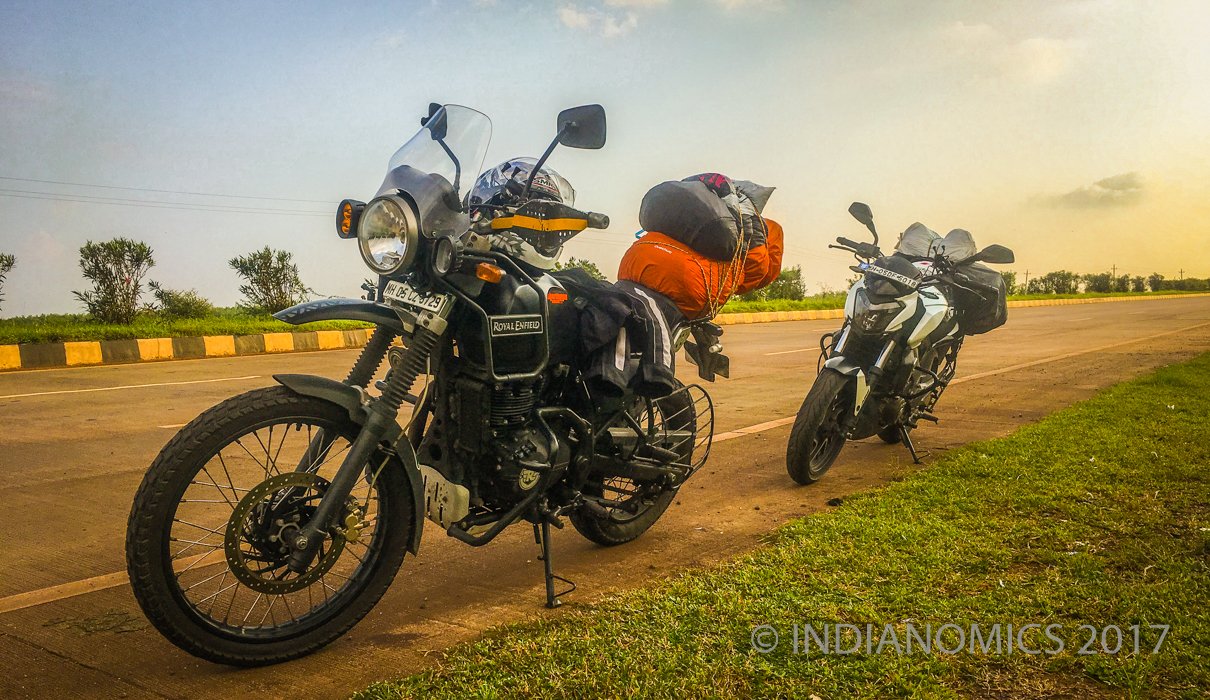
    Our rides – motor bikes

    Tyjo Thomas owns a Bajaj Dominar 400 that he got some months ago. Dominar 400, based on the KTM390, heavily modified for cursing comfort and mild on-road manners by Bajaj. It is a bike that has potential to challenge Royal Enfield’s rule in this 350+ CC segment.

    I own a Royal Enfield Himalayan. If you are regular here, then I am sure you will know about it. I call the Himalayan as Yeti, and there are tons of things I have already spoken about my bike.

    Riding rules

    We were clear on a few things before the ride started.

    1. We will not be riding in the night, though start as early as possible in the mornings.
    2. Do approximately 600 to 650 kilometers a day at the max, which ensured we are not too tired and have enough flexibility to take longer breaks.
    3. Ride consistent speeds averaging around 80-90 KMPH
    4. Spend money on only absolute necessity.

    PS: We did break one law though, by riding on the Mumbai Pune expressway.

    Capturing the beauty

    We met another wolf Nikhil Deshmukh who helped arrange for two SJCAMs on loan, for us to record our trip, which was a huge favor that he did for us – for you can see in the video, we managed to capture a few clips that left us in awe. After the ride, my daughter has seen these videos again and again, and I love it every time it throws a smile on her face.

    • Two SJCAMs – thanks to Nikhil
    • One Sunco Cam – thanks to Shiv, though I could not use it as a backup camera throughout my trip due to a faulty memory card
    • My beloved iPhone 6s, Lumia 950XL

    Prepping our bikes

    Given that this is the longest ride I have done, it was imperative that I take Yeti to the service center for a thorough check-up. I was close to my 4th service anyways, so decided to go ahead and do it as well. Royal Enfield’s Pooja Motors service center immediately prioritized my servicing request, since the ride was just two days away.

    Likewise, Tyjo also got his Dominar serviced the previous day. Given his tight work schedule, he did not have the liberty to get things done as I did.

    After the servicing was done, armed with a new magneto coil replaced voluntarily by the SC, I took the bike to pimp it up a bit the next day. I needed fog lamps installed on Yeti, just in case we need to ride in the dark. My focus was to ensure that I am not distracting the drivers/riders from the opposite side, but make sure I am visible enough.

    Thankfully, I got a fog lamp and led white light combination (which I had secretly wished) because the store did not have two fog lamp units readily available. I also upgraded my helmet to an SMK Twister (with a Bluetooth headset) from my existing LS2 (I lost my brand new SOL Infiniti a few months ago in an impossible way) and got a knee guard, something I never had before. I will shortly write up a review of my brand new helmet and how much it helped me during this ride.

    Bluetooth headset served two purposes; one, since we relied on maps massively, it was easy to ignore looking into the screen all the time to check if we need to change direction. And two, it helped me be in touch with my daughter without removing my helmet.

    What we packed?

    Tyjo had got a tail bag, and I got my Wildcraft trekking bag, and a backpack. Both of us carried sleeping bags as we had anticipated sleeping in places that would cost us almost nothing. Even though, we never used them as we managed to find places to stay within our affordable reach.

    We carried underwears for seven days and enough tee-shirts, jeans, and shorts to last us three days. We knew we had the opportunity to wash them once we reach our respective destinations.

    Both bikes did not have saddle stays, and hence no saddle bags. I packed my backpack with essentials I would need, including my laptop and a backup phone. Based on Tyjo’s experience, we also picked up two dozen of Snikkers for quick bite if required (ended up sharing and eating it with families)

    And for the bikes?

    For the bikes, I had carried an entire set of Allen key, screwdrivers, and spanners. Tyjo did likewise, though he got his set of Allen keys from Nikhil. We also got a breakdown rope in bright orange from Nikhil, just in case we face some difficulty.

    Tyjo also carried a chain spray, and both of us used it. I inadvertently forgot to take RE Chain spray can I had at home. They say at every 500 kms, we should spray the chain and clean it, which we did. I did face issues with the Himalayan, but that will be an individual article, the link you will find here in future.

    Day one – Mumbai to Hubbali (Hubli)

    We set to ride early in the morning from our respective places at 5.30 am. The bad patches towards Panvel, and the traffic + chaos it caused delayed us a lot. We also did something spectacular though, something we should not have done. We took the Mumbai Pune Expressway after Lonavala. I know, we should not have. Primarily due to map directions (forgot to switch off tolls) and then neither of us ever rode to Pune on a bike before.

    Breakfast

    We stopped at Pune for a healthy Puneri meal. TGW Wolf Nikhil Deshmukh rode down to meet us and hand over two SJCAMs. Very crucial for our trip, we guessed. As the video shows, it sure was a brilliant idea.

    I did carry cam from my friend Shiv, a Sunoco. However, it was my backup in case the SJCAM lost steam or if Nikhil could not manage it for me. After having our breakfast and a quick camera set on Yeti, we were ready to ride. Tyjo forgot to get 3M tape for his helmet mount (again, something that Nikhil got for him), and hence we decided to proceed hoping to buy one at Hubbali.

    We rode towards Hubli via Kolhapur. After the initial hiccup in the traffic at Pune, we were soon riding the empty roads. The best section this side of our route was the Satara Ghats. The three-lane ghat roads were super comfortable with traffic, and I could almost corner my Yeti with my knees almost touching the tarmac.

    Unfortunately, for a reason unknown, the SJCAM stopped working after I took the first corner – and hence, could not see how I took the rest of them.

    Lunch at Jai Hind

    We were on time as per our route plan and reached Kolhapur around 1.30 pm and stopped for lunch. And here is where we encountered one of our exceptional hospitality experience in this whole trip at the hotel named Jai Hind, which is off the highway.

    Honestly, we were tired. And, yes I forgot to do a lot of things – like asking the guy his name or taking a picture. We were too focused on riding and getting to our destination for the day in time.

    As soon as we entered the hotel, this guy (must be around 45, sports an orange beard) escorts us to a place where we can keep all our unmounted luggage. He directs us to the washroom, then to the handwashing area and then asks us to take a breath and think of what we want to eat.

    This guy goes about suggesting what is the best that he can offer considering we are riders. He hints on little rice and more of vegetables and egg. We stick to the later, as rice tends to make us sleepy in our routine lives.

    Food was nothing to write home about and was average at best. However, the best was yet to come. Tyjo candidly asked if we can rest on our backs on the chairs – and immediately the answer; sleep till evening if you so wish.

    The masala tea story

    With our backs on the chair and looking up at the ceiling, Tyjo wonders if we should drink tea. I inquire about it. This guy (I seriously am feeling sad not to have asked his name) is quick to say that you will not get the tea as we get in Mumbai.

    I prod him for masala tea, instead. Or ginger tea. Of course, they do not serve it there. Not one of the regular requests in this part of the country. After a while of resting when we were about to make our move (oh yes, we forgot about the tea) is when the tea comes in.

    And yes, it is masala tea with ginger! We could not believe it, and that brew was fantastic. From expecting a plain tea to forgetting all about it, and then to have this guy deliver what we hoped for – that never was available at first place. The bill was a total of Rs. 260/- for a service that was close to a 7-star treatment for us in pure Hindi!

    Do not have words to explain. I will leave it at that. 

    Stay at Hubbali

    We moved ahead towards Hubli. The roads were pretty neat, and we could make it to Hubli in time as per our schedule. 6.30 pm, touch the city. Looking for the place turned out to be tricky, as Maps kept redirecting us. And finally, we made it to  Kutchi Bhavan.

    Thanks to my friend Jiggu whom I met after 13 long years, we had room to put our heads down. Jignesh also helped us get 3M tapes from Hubli market, and played host to an excellent dinner along with his wife, Darshana. It was my first time meeting her, perhaps not the best impression I could cast!

    Day two – Hubbali to Wayanad

    Next day, we left early in the morning at 6.00 am, instead of planned 4.30 am! Here on, unfortunately, we did stick to this routine and made it worse. More about that in the text about coming days. The exit was easy from Hubli, and soon we were doing 120 kmph on the empty stretches of highway. Around 8.30 am, we stopped to fill our bellies.

    The breakfast cheat

    On this ride to Kerala, we forgot we were in Karnataka till we asked for the bill for our meal. Breakfast at a roadside shop next to the second toll booth on our way ended up paying Rs. 280. A meal that should not have cost us more than 100 rupees at a premium. We paid less for an excellent service plus lunch at Kolhapur the previous day. The shopkeeper realized that we weren’t from here, and may have thought that we were riding expensive bikes (well, in a way) so why not ask for the money he wished?

    Our mistake? Yes, a big one at that. We did not ask for the price of what we were ordering – so the shopkeeper was free to quote whatever he felt (80 rupees for two liters of bottled water). This place is not a proper hotel, and I am talking about just a roadside shanty shop.

    When in Karnataka, always ask for the price first. We decided not to engage in a war of words in a place we did not know the local language to speak. It was not that much worth a risk, given that the area was mostly empty.

    Lunch at a Sisidi!

    We stopped for lunch at Cafe Coffee Day outlet near a petrol bunk, and that is when I checked my WhatsApp which left a jolt. We need to make it to the entrance of Bandipur National Park before 6 pm. The entry time was not part of our plan – and something that we should not have missed! Darn, if we knew, we would have been a bit less relaxed.

    Again, thanks to Nikhil who was informed by Rahil, as he had passed through the area couple of days ago – else we will not be let through the forest area. Suddenly, there was a panic, and we were drifting through plans of what to do in case we don’t make it.

    The best option to consider, was to divert to Ooty, though this will mean we will be riding through the mountain in pitch dark. Also, an expensive proposition.

    However, soon I realized that we can still make the entrance and we were calculating the estimated time to reach Wayanad as beyond 7 pm, and hence confusing it with entry time at Bandipur which we can approach one and half hour prior.

    Bandipur National Park

    We gunned the bikes given that the roads and highways were smooth in Karnataka, and were relatively empty. Hardly we faced any traffic on N.H. 48 or other diversions we undertook. We made it to the entry gate to Bandipur National Park by 5.30 pm!!! Hallelujah.

    A sigh of relief, both of us stopped to switch on our cameras so we can capture the ride through the jungle. It is in the evenings that elephant herds move across the roads. In the night, the numbers shoot up like crazy, and it is practically impossible to drive or ride through. Let alone; you encounter their wilder side.

    It is fascinating to ride through the jungle, with smooth roads. Speed breakers help you slow down. No, not for animals to make you their easy dinner (or play toy if its an elephant), but to stop you from killing them.

    As we progressed through, I was lucky enough to miss an elephant crossing by a whisker. I mean like if there was a  2-3 seconds delay and I would have hit an elephant or vice versa. You can see in the video, how close I was! That was perhaps my first encounter with wild animals in the jungle. Of course, I have seen and touched and ridden atop an elephant, all of them were domesticated. So this did send chills down my spine for a few minutes.

    Entering the lustfully green Wayanad

    In a little while, we knew we were in Kerala – as it started raining heavily (pun intended). From then on, it is a drenched ride! While in the middle of the forest, it started raining. We stopped at the end of the woods, completely drenched, to get our hands on a hot glass of Kerala tea and wait for the storm to pass. It also played its part in delaying us further, as we could not speed up in the twitchy roads (ghats) of Wayand. With no luck on our hopes, we started riding towards my friend Dijosh’s house in Wayanad.

    By the time we reached our destination, it was already 7.30 in the evening. It took us another 30-40 mins to unload the bags and remove our safety jackets and knee guards. A hot bath helped refresh us a lot, and the steamy dinner just added to our delight.

    Day three – ride to our final destinations in Kerala

    I cannot thank Dijosh and his family enough for taking care of us like we are kids. Dijosh and I have been good friends since 2005, and our families know each other well. Tyjo and I ate to our heart’s content the homemade delicacies that both of us always yearned!

    The dinner and the early morning breakfast were a feast. The morning meal reveals a ritual unknown to both of us (I am brought up in Kerala, Tyjo is a born Malayali) of eating Puttum Kadalayum with the fabulous Kerala Papadom. I never imagined it before and will ensure I do it every time I am eating Puttum Kadalayum. Loved it that much!

    Dijosh and his father escorted us through Wayanad in his brand new Skoda Rapid and visited the Pookode lake. Since we left at 7.30 am, the access gate to the lake was not open yet. We roamed around the roads on the lake bank and turned around to move from Wayanad. Got our luggage from the car, and off we went, saying our goodbyes to our wonderful hosts!

    Thamarasherry Churam, Wayanad Dist., Kerala

    The moment of madness was to ride via the Thamarasherry Choram – the nine hairpin scenic beauty. During the plan for this ride, Tyjo made it clear that we travel through Wayanad to enter Kerala. Unaware of the extravaganza, our experience at the Churam was wholly impressive. Tyjo had his fill of the beauty of Wayanad, and it is pretty evident from his expression captured with the camera. Hear it in the video posted above. It was perhaps our best ride experience in Kerala.

    Wayanad is beautiful, and if you ever get a chance, do visit. Ride from Wayanad to Alleppey was about 300 kms; however, the dangerous condition of roads and the disobedient traffic made it difficult for us to travel. We struggled through Mallapuram and the outskirts of Calicut (Kozhikode) to ride through.

    60KMPH Limits

    Kerala has the stricter speed limit implementation with speed cameras installed across many of the highway spots. They take a picture of you speeding and courier you a ticket at home. I would not know it anytime soon if the authorities decided to send me one as well, as this takes typically anywhere between one to four months.

    We did exceed limits, however not by much. With 5th gear engaged at 60kmph on my RE Himalayan, I could not continuously ride at that speed. It caused unwanted (because I was exhausted) vibrations, which are standard.

    Especially after Tyjo and I parted ways, I tried to keep it between 65 and 70 kmph. And at times when I overtake vehicles (many cars too are driven at 60-70 most of the times), I touch 80 kmph. I saw a couple of manned speed guns while doing those speeds but no one stopped me (well, through our entire ride no one stopped us!).

    Here is hoping that the guys behind the screens have ignored my peevishly exceeded speed limits.

    The traditional Kerala Sadhya for lunch

    By noon, we stopped for lunch somewhere in the Thrissur district. It is hard to spot a restaurant that was operating in this area – which did surprise us. The rare one’s we was too crowded for us. Also, the fact that we had to decide whether or not to unload our bags from the bikes mattered in the decision. So hungry as hell, we decided to chance upon the next available place that sold food.

    Thus we reached a small, roadside hotel. Eating excellent food, both I and Tyjo were having a blast enjoying the traditional recipes. Tyjo preferred to gorge on the beef dishes, which he missed since the beef ban in Maharashtra. I stuck to my vegetarian stuff – the famous Kerala Sadhya.

    The food was delicious, and cheap, as we only spent Rs. 120 for a fulfilling lunch.

    The ruined surprise!

    My parents and family back in Kerala did not know I was coming! Yes, I did successfully hide that fact. Up until Thrissur, that is. I called up my aunt (dad’s younger sister) to let her know that I was coming and asked her to reach home as well. While I did tell her that it was a surprise, but I guess she didn’t get the right memo. My short-tempered father received me with his anger later!!!

    Riding ahead and parting ways

    Tyjo and I parted our ways at Thrissur bypass for our respective destinations. We stopped, bid adieu to each other with the promise that we will be in touch soon. Tyjo had already gulped the fact that his family in Chalakuddy is not going to let him ride further south to Varkala and Kanyakumari given the limited time he will be spending with them.

    Solo ride to Alleppey

    There on, I was riding solo, perhaps the longest solo ride I ever did. Riding through Ernakulam and Aluva was a nightmare due to traffic. The metro seems to have made the traffic situation worse, though I saw little traffic aggression at the lights. Almost everyone was halting before the white line. No cramming of cars and bikes into any space available – it is a departure from what we see in Mumbai-Thane belt. Roads in this part of Kerala are clean and pothole free and enjoyable otherwise.

    Soon, I was in familiar territory. I was riding through Aroor and Chertala, the roads that I have seen growing up. I did not need a map through this route, but the continued rain had drained me a lot. Exhausted, I took a break after Pathirapally to tank up and make a few calls.

    Reaching my hometown!

    As I approach my home, which is just five kms away, I face one of the worst traffic on this route. Cars and trucks hardly moved, and this when I decided to use my Himalayan’s off-road abilities. Riding through knee-deep, filled-with-mud potholes on the side of the road to get rid of the traffic and rush home.

    Finally, I reached the place where I grew up, the place that is still living in the 20th century. I passed by my alma mater, Leo XIII H.S.S. and suddenly the fond memories of childhood flashed through, occasionally interrupted by the speed bumps and potholes.

    Sure enough, my father was waiting for me – wondering where I was and why I decided to ride a bike all the way to Alleppey. Of course, for family, safety and security of their kids are paramount. Of course, the most substantial portion of the older generation will never understand this stupidity (for them, at least).

    Finally, I was home!

    Further reading

    The write up to the return leg is in the works, so is the ride experience on Himalayan and Dominar. Be sure to visit again in a week’s time to see more of our adventurous ride to Kerala.