It was a funny Tax Poem WhatsApp forward that I got today that got me thinking about the number of stuff that we buy that are taxed. The coffin services, included. Here is a quick one for you to laugh and ponder over how much we pay the tax.
The Union Budget was presented yesterday which focused on various sectors and reforms, however gave little or nothing to the salaried middle class tax payer who bears the cost of 99% of the people in this nation.
Arun Jaitely was coy enough to mention that Business’ taxation is far less than the amount received from salaried tax payers, to further the furstration. I hope the small and medium scale business who avoid paying both direct and indirect taxes are brought under the tax net and salaried class be relieved from taxes.
The Tax Poem
Tax his land, Tax his bed,
Tax the table At which he’s fed.
Tax his tractor, Tax his mule,
Teach him taxes Are the rule.
Tax his work, Tax his pay,
He works for peanuts Anyway!
Tax his cow, Tax his goat,
Tax his pants, Tax his coat.
Tax his ties, Tax his shirt,
Tax his work, Tax his dirt.
Tax his tobacco, Tax his drink,
Tax him if he tries to think.
Tax his cigars, Tax his beers,
If he cries, then tax his tears.
Tax his car, Tax his gas,
Find other ways To tax his ass.
Tax all he has Then let him know,
That you won’t be done till he has no dough.
When he screams and hollers Then tax him more,
Tax him till he’s good and sore.
Then tax his coffin, Tax his grave,
Tax the sod in Which he’s laid.
Written by someone anonymous, this poem pretty much sums up my experience as a tax payer.
Budget 2018: Finance minister Arun Jaitley will present the Union Budget for the year 2018 in the Parliament. As it is expected, this budget will largely be limited to appeasing people in preparations for the upcoming General Elections in 2019. This is the last full budget for the BJP government, and hence their last full chance to impress the aam-aadmi in an attempt to woe the vote bank.
Here are the five core areas that will make or break this budget for the population at large.
Personal Income Tax rate reductions or increase in tax saving slabs, change in taxes for capital gains (share trading)
National wide Farmer loan waivers or deductions and focus on agriculture produce sale prices
Fiscal deficit breaching its decline
Infrastructure investments to boost jobs
Revised GST Rates for products and services, petroleum products coming under the ambit of GST
The Budget starts at 11.00 AM and we will keep you posted.
Union Budget 2018 – India’s finance
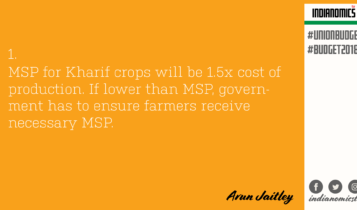
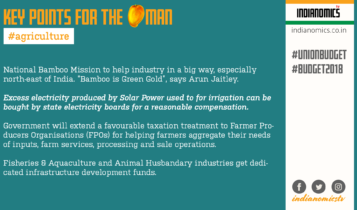
MSP for Kharif crops will be 1.5x cost of production. If lower than MSP, government has to ensure farmers receive
necessary MSP.
Government proposes to launch Operation Green for which a sum of Rs 500 crore will be allocated.
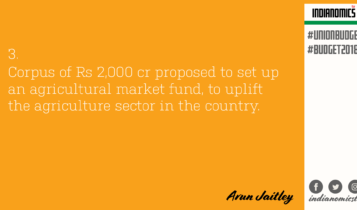
Corpus of Rs 2,000 cr proposed to set up an agricultural market fund, to uplift the agriculture sector in the country.
Government proposes to launch Operation Green for which a sum of Rs 500 crore will be allocated.
FM proposes to extend kisan credit card to fisheries & animal husbandry farmers and allocate Rs 10,000 cr for fisheries & aquaculture, animal husbandry funds.
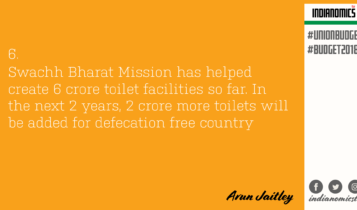
Swachh Bharat Mission has helped create 6 crore toilet facilities so far. In the next 2 years, 2 crore more toilets will be added for defecation free country
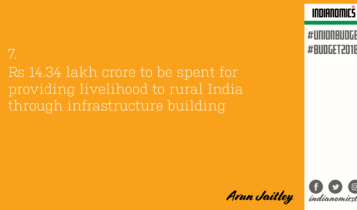
Rs 14.34 lakh crore to be spent for providing livelihood to rural India through infrastructure building
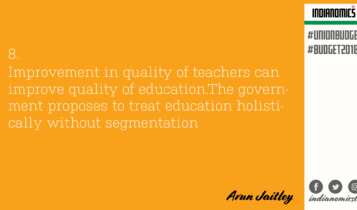
Improvement in quality of teachers can improve quality of education.The government proposes to treat education holistically without segmentation
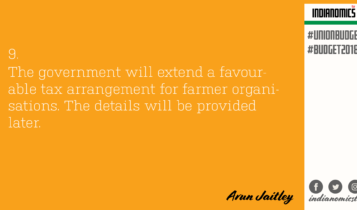
The government will extend a favourable tax arrangement for farmer organisations. The details will be provided later
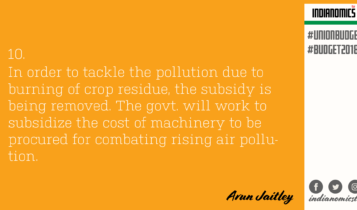
In order to tackle the pollution due to burning of crop residue, the subsidy is being removed. The govt. will work to subsidize the cost of machinery to be procured for combating rising air pollution.
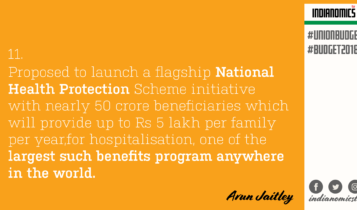
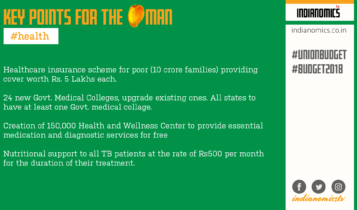
Proposed to launch a flagship National Health Protection Scheme initiative with nearly 50 crore beneficiaries which will provide up to Rs 5 lakh per family per year,for hospitalisation, one of the largest such benefits program anywhere in the world
Government will introduce 24 new
medical colleges including upgrading certain existing colleges. This will ensure there is 1 government medical college in every state of the country.
We are allocating Rs 1 Lakh crore in the next four years to boost Research and Development. We are also coming up with a specialised railway university at Vadodara.
By 2022, every block with more than 50% ST population and at least 20,000 tribal people will have ‘Ekalavya’ school at par with Navodaya Vidyalas
Mass formalization of MSME sector is happening after demonetisation and GST. Rs 3,794 crore is was set aside for MSME last year for mass formalisation. The government will soon announce measures to address non-performing assets of MSMEs.
The government will fund 12% of wages for new employees of Employees’ Provident Fund in all sectors. Take home salary of new women employees to go up in the formal sector. Only 8% PF to be cut in first three years. There is no change in EPF.
Integrated BEd program to start soon, with teachers training as the main focus. Rs 1 lakh crore to be invested over the next 4 years for a new drive to boost Research and Development.
We propose to expand capacity by five times at airports under AAI. 1 Billion trips each year. UDAN will connect 56 unserved airports and 36 unserved heliports. We are ensuring that even those citizens who wear hawaii chappal can fly in a hawai jahaj.
The allocation of Digital India has been doubled and the government proposes to set up 5 lakh WiFi hotspots. The government does not consider cryptocurrency as legal tender and will work towards eliminating illicit transactions going on through crypto assets
35,000 km will be completed under Bharatmala project with outlay of Rs 5.35 lakh cr before moving on to the initiatives in Railways.
Cash payment at toll plaza no more. The government will introduce a toll system based on pay-as-you-use module. We will also bring out an industry-friendly defence production policy. Two industrial defence industrial development corridors to be constructed.
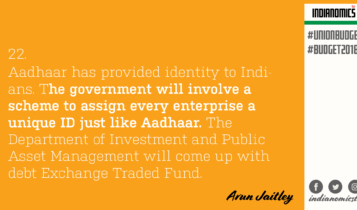
Aadhaar has provided identity to Indians. The government will involve a scheme to assign every enterprise a unique ID just like Aadhaar. The Department of Investment and Public Asset Management will come up with debt Exchange Traded Fund.
Government insurance companies to be merged into a single entity, and subsequently listed in the stock exchange, as part of the disinvestment programme. Rs 80,000 crore disinvestment target for 2018-19, target for 2017-18 has been exceeded and will reach Rs 1 lakh crore
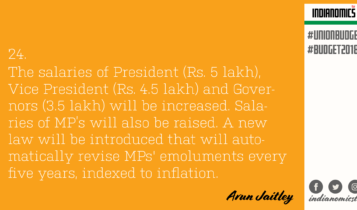
The salaries of President (Rs. 5 lakh), Vice President (Rs. 4.5 lakh) and Governors (3.5 lakh) will be increased. Salaries of MP’s will also be raised. A new law will be introduced that will automatically revise MPs’ emoluments every five years, indexed to inflation.
Revised fiscal deficit estimate for 2017-18 is 3.5% of GDP, fiscal deficit of 3.3% expected for 2018-19. GST revenue for only 11 months is 21.5 lakh crore. Tax
buoyancy for 2017-18 is at 2.11%. Number of tax payers has increased from 6.47 lakh crores to 8.27 lakh crores
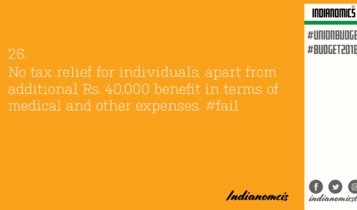
No tax relief for individuals, apart from additional Rs. 40,000 benefit in terms of medical and other expenses. #fail
Relief on tax for senior citizens from income coming from bank interest increased from 10,000 to 30,000. Fixed Deposit/Post office interest to be exempt till Rs 50,000 80D benefit enhanced to Rs 50,000.
Live updates will stop now. We will update the post with impacts of the budget proposals on common man.
Elon Musk is making all the right noises, and for the right reasons. He first went electric with his Tesla, and now is building a Solar City that will harvest solar energy. A perfect brand ambassador for the title of this article, Go electric, via Solar. However, it is a sham to think humans are difficult to convince.
Countries generate a significant chunk of their electricity from burning fossil fuels. The need is vital, given the consumption levels and lack of alternatives. But the need to burn fossil fuel was not!
Put the space available to some good use, shall we?
Think of it this way. You are hungry, but the store near you only wants to sell you oranges, as he has got a lot of it. He goes to the government, lobbies (possibly bribes) and convinces the government to provide benefits for selling oranges.
Due to this, the country does not encourage apple farmers for example, and focuses on oranges, thereby ignoring farmers ability to increment apple’s growing and production techniques. Since apple production is less in numbers, they cost significantly more and are not easily accessible. To amplify this, you are also discouraged from buying apples with a lot of negative publicity around it.
If you got the drift, well done. You can use this as a base to understand how Trump won the elections. If not, read on.
I will use the example of cars here to make it easy for you. Companies and people who had invested heavily in fossil fuel and related businesses (car and oil producing companies primarily) pushed the government to ignore the idea of electric vehicles, so people continue to use petrol (gasoline). It would help them not make a new investment in technology for alternative fuel or electricity-powered cars, thus also ensuring their current business remain successful.
Every major industry follows this approach to remain in business by not innovating. As usual, the herd mentality. In fact, those who challenged this de facto malpractice, are silenced in a way or another.
Challengers grew!
These manufactures for the sake of their profit and existence put the future of earth at risk. Today we are all used to a way of life, designed by the very people who were only profiteering.
But keeping a sound idea suppressed for long is difficult. And likes of Elon Musk rise to the occasion. In this specific example, car manufacturers themselves sensed their future at risk and started investing in either the alternative fuel or electric cars. A small victory right there, but the cost is still prohibitive.
Electricity costs a lot of carbons
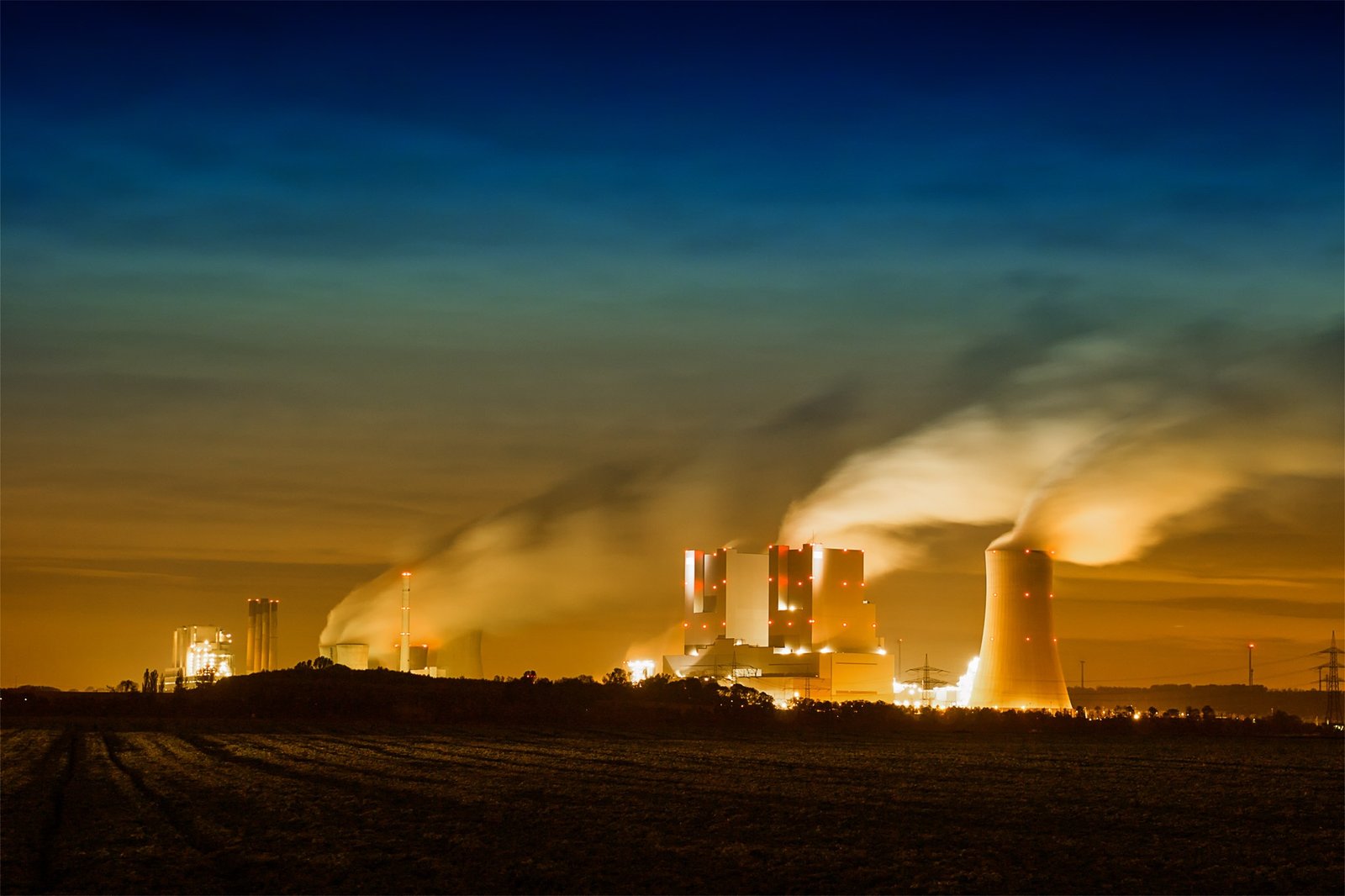
The cost I am talking about is not only financial but to the environment all the same. Government or private girds produce electricity from many forms. The hydro-dam, the solar, windmill, and nuclear reactor based electricity generation do not cause environmental pollution. They only have a small share in the entire production span across many countries.
Hence it does not make any sense to use an electrically powered car when burning fossil fuels generate the electricity. We need to go Solar.
Why solar?
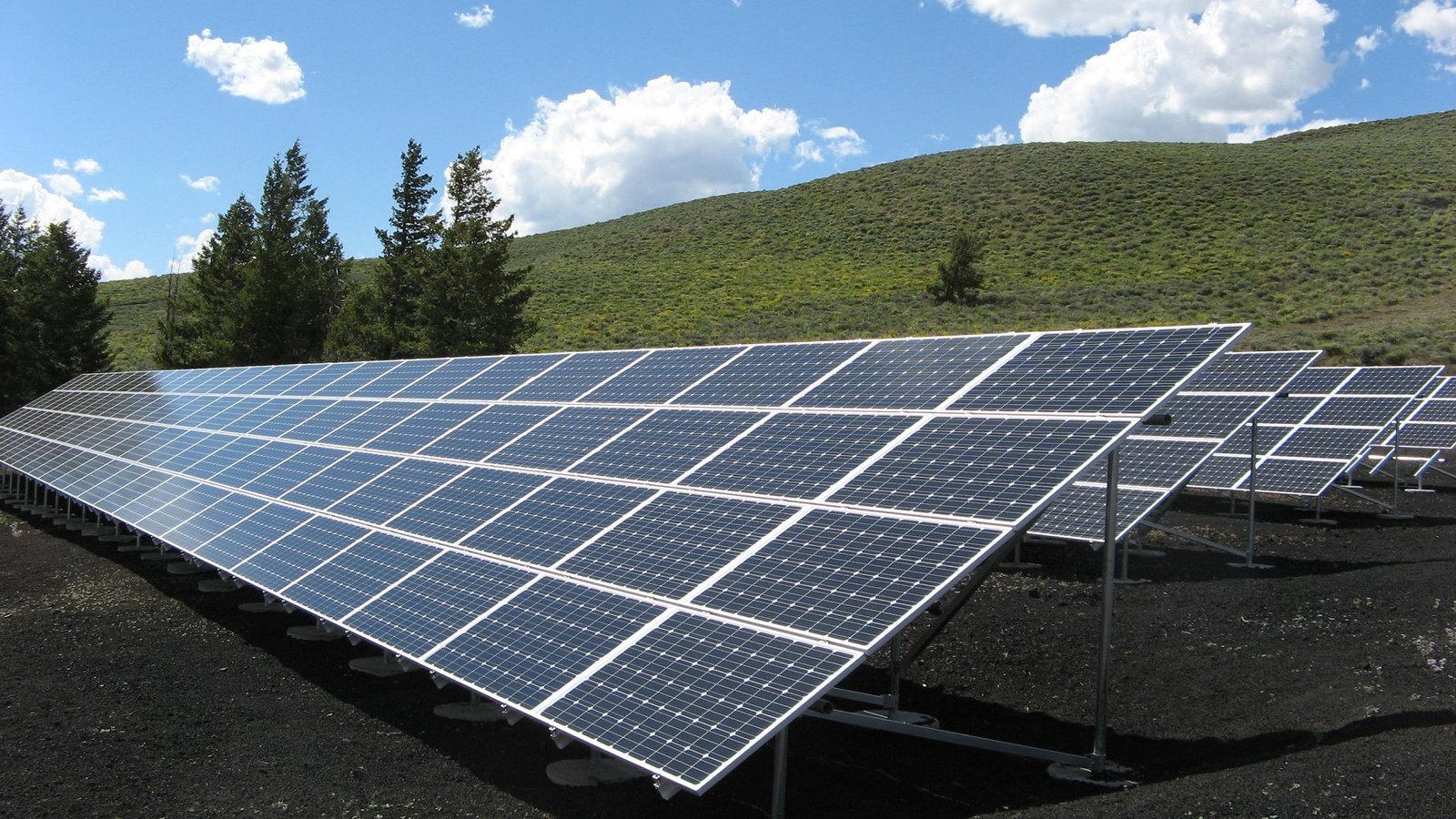
I do not think anyone asked this question – except to douse their curiosity. Of course, you need ample amount of sunlight. Of course, you need a lot of space to plan these giant solar panels. But this is the cleanest form of energy.
Here is an excellent example of how a place consuming more than 18,000 Units a day saved all of them, thanks to Solar. Cochin Airport is world’s first and only fully solar powered airport.
Solar energy is still costly for an average homemaker to buy, however larger institutions can afford it. Cochin Airport is a perfect example of this greater good.
Sixth element: Electricity
Going forward, the world’s reliance on electricity will only increment and hence, it will remain one of the most sought after ‘element’. The reason I call it so is because, we already have polluted our earth, water, and air – the three most fundamental needs for human life to exist on earth.
I will write more about electricity as sixth element in a more detailed article.
Innovation in Solar Energy Harvesting
Innovation in solar has got a boost in the last decade. However, we have only seen a dramatic increase in installations in the previous two years. Climate change or not, the weather conditions have made a lot of organizations and governments take the right step into the future. I want to talk about a few of the innovations that will help the planet earth greatly.
Thin Film Solar
Most of us remember Solar panels as gigantic, like in the featured picture on this article. However, the innovations in this field have to lead us to thinner films that help make manufacturing and installing a solar panel cheaper, more accessible and practical. Thinner solar films can be pasted onto the roof and walls (not as much efficient) to generate electricity. Absorbing the sunlight means, less heat gets passed on to the roof at the same time, thus making the roofs cooler (and saving cooling costs). To be commercially launched, but future is already looking bright.
Solar Windows
Another innovation that has great potential is Solar Windows. A company by the same name has successfully created prototypes of glass that has the potential to converting sun’s energy into electricity. Solar Windows can change how the city sky scrappers draw current from the grid, powering themselves with Solar Windows placed on their building exteriors.
Nanowires based panel
Also called the Hairy Solar Panel, these use carbon-nanotube fabric laced with light-absorbing nanowires, which can absorb more energy from the sun. They are better than the silicon-based panels and can be more efficient in solar harvesting.
Efficiency
How many of you know about the efficiency of gasoline combustion? They burn at average 28% to a max of 55% efficiency in rare cases, wasting the remaining fuel in heat. Likewise, Photovoltaic cells have their limits on how much electricity they produce as well, vis-a-vis the total solar power available.
Other Innovations in Solar energy
Apart from improving the panel technology, other areas saw a lot of action as well. These include solar plant set up, distribution and innovative ideas on how to spread the usage of solar. Having your solor plant will help you make money in future, so what are you waiting for?
Microinverters
Solar panels produce power in Direct Current or DC (invented by Thomas Edison) for effortless storage. Our homes are wired to work on Alternative Current or AC (invented by Nikola Tesla). The old set up of inverters used to be inefficient and cost intensive. However, the advent of microinverters has helped make setting up a solar power plant affordable and efficient.
The current average is 23% globally. However, efforts are on by many companies achieve much more than that.
Improved Storage
Batteries play a crucial role in solar-power generation. If the solar panels connect to the grid, you do not need to store the electricity. In all other cases, there is a need to save excess power that produced, so that it is available for use during night time or when limited sunlight is available.
Batteries did not improve at the same pace as other technologies, as efforts were made to get better at converting the heat/light into energy. That is changing, and pretty fast as now, we race to store ever more power in the smallest possible package. Tesla leads in that today, offering better battery packs at less than half the cost.
Solar Tethering
We all have used data from our phones, connecting it via WiFi to our laptops where there is no LAN or local WiFi connectivity available. Solar tethering works somewhat in a similar fashion.
Solar plants require an expense commitment before you can start getting returns on your investment. At times, these can be expensive for average homeowners. Hence, to those who have managed to generate more than what he can consume, the private or public city grid can buy the excess power.
In turn, the excess energy can be purchased over by a buyer who wants to use solar but does not have money to invest in a plant. He can pay for the solar unit based on fixed price, thus making income for the harvester.
Portable Solar Lights and Fan
A large part of the world still has little to no access to electricity. Mini Solar plants, attached to portable lights and fans help get then access to basics during night time. These compact lamps also help charge mobile phones, run other local business tasks, etc.
There are many such projects in Africa and Asia, which have met with tremendous success. Such small solar power plants help make life easier for the populace in remote regions.
Water desalination and purification
Another exciting innovation is in the area of desalination of water. A team of scientists from MIT and Jain Irrigation Systems have come up with a method to desalinate seawater, disinfecting with UV and make it available for people who lack access to drinkable water.
As again with the previous point, electricity and water are scarce resources for many living in remote areas. Drinking clean water helps reduce water-borne diseases, but most of the villagers do not have access to them.
Conclusion
Harvesting Sun may still be expensive to install, and return on investment is not quick enough, but the advancing technology is making it easier and much cheaper. We can fix Solar panels in all those areas that receive maximum sunshine throughout the year for best effect. However all those areas where we do not have enough sunshine, we will need to export electricity from where we can generate.
There are various teams of experts; some are making floating solar panels in the sea, some others are testing balloons in the air, while another group is trying to capture the non-visible light spectrum (like infra-red). Sure, there is future in it.
I hope that we limit carbon production, lest we may face a carbon-cloud future, where solar may not help.
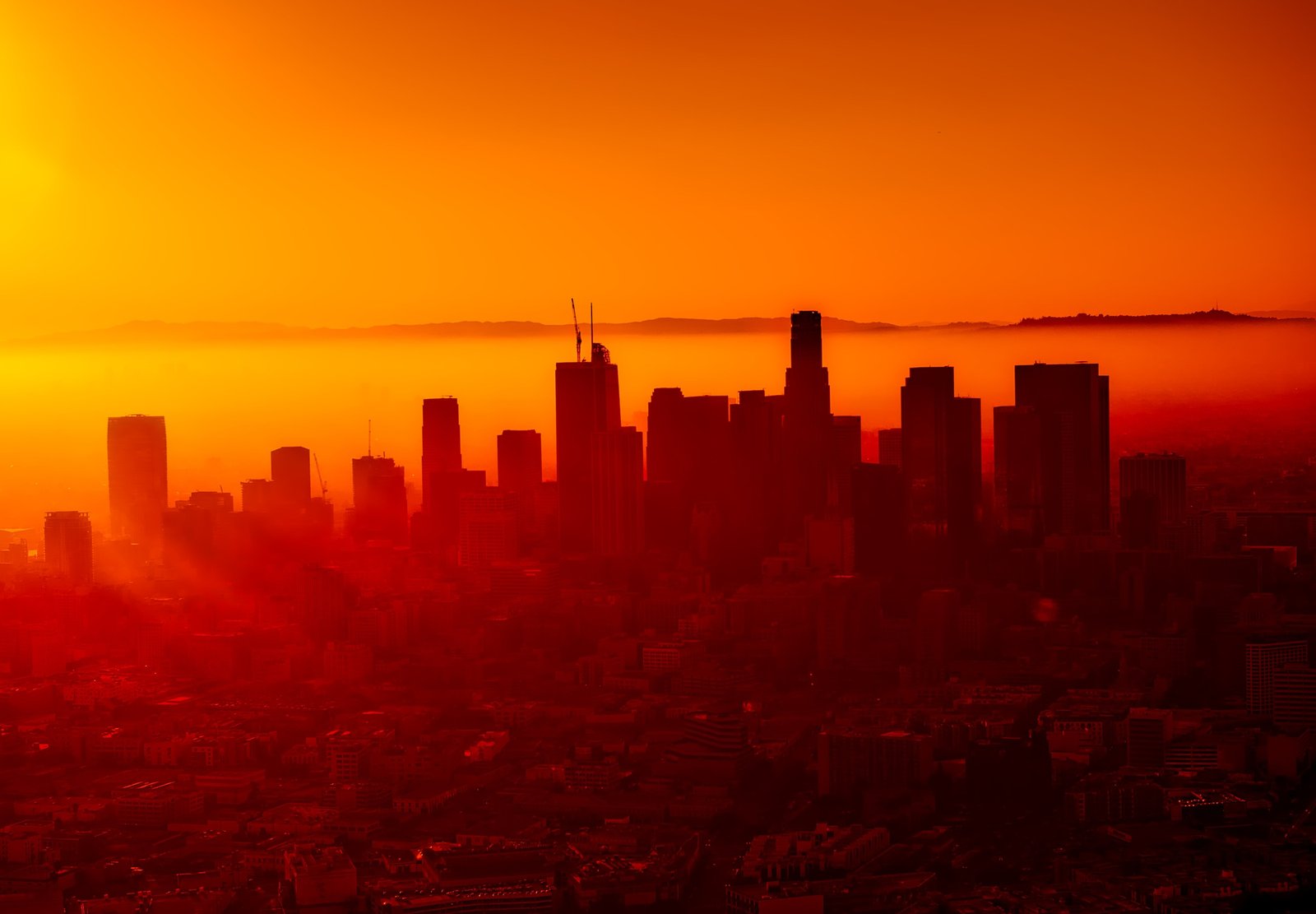
If you have taken a recent trip outside of India, I am sure one thing that you would resonate is how difficult is to breathe once outside of the airport anywhere in India, due to higher pollution levels. I faced a similar situation way back in 2011 after my US trip for business. It felt like I wanted to get back into the Airport instead. Last time I was worried about the climate, I ended up buying an air cooler.
Of course, I am sure you have also read a lot about the new ban on crackers by Supreme Court of India. The court had to enforce it because of the deteriorating breathable air for the common man. Let us look at what causes the pollution, shall we?
Air Pollution in India
Air pollution is a severe issue in India, however, has not seen enough action across the board. Last year, it was the odd-even number plate scheme in New Delhi that clogged the news, while it was Diwali and Crackers this year.
If it does not ring a bell, you can read about it on Wikipedia. Yes, there is a dedicated page for Air Pollution in India on the Wiki. It has been a controversial topic to be discussed, given that the United States of America also has been showing withdrawal sings from the global accord at the Climate Change Summit. Donald Trump and his policies deserve a separate blog post in itself.
Fossil Fuel and Biomass
I am sure you know what fossil fuels are. Exactly, the liquid stuff that powers our cars and bikes, trucks and heavy equipment. While these are a necessary expenditure that you have to make to go from a place to another before electric vehicles are popular, Fossil fuels are also used to produce electricity.
With ever increasing vehicles on the road, and increase in numbers of cars on the way these days only accentuates the problem we have at our hand. These vehicles emit the harmful gases and particles in the air that we breathe and makes us sick, slowly but surely.
Pollution – what are we breathing
Fuel Adulteration
An extension of the above topic, in India it is hard to find a fuel station that sells the pure form of fuel. Adulterated fuel causes vehicles to emit excess pollutants in the air…
Fuel adulteration is so rampant in India that every other car emits far more toxic fumes than it should. India recently decided to skip BSV standard and jump directly from BS4 to BS VI (BS 6) so that it can catch up to the US and European standards.
The Pothole and Traffic story
If you are living in Metros, then you know the traffic. And you also know, the conditions of roads in India. I am not talking about the highways though. My recent trip to Kerala makes it abundantly clear that highways are laid using much better quality of tar and rocks than their city counterparts. One word on the cause is corruption.
The more the potholes, more the traffic. With ever increasing vehicles on the road, traffic situation just amplifies the amount of bad stuff in the air that you and I breathe.
Factory and other pollutants
Fumes coming out of factory has even contributed to Taj Mahal losing its sheen. Burning ‘gobar’ (cow dung) and setting fields on fire after harvest is another cause.
With so many of the contributing factors, it is difficult or near impossible to contain the pollution. Here is a possible view into the future, where Oxygen kits will be treated the same way as drugs, and you will pay through your nose (pun intended) to breathe fresh oxygen.
Acted ably by Jackky Bhagnani and Nawazuddin Siddiqui, Carbon is a short film by Royal Stag Large Short Films should be an eye-opener!
Pollution – what are we breathing
So what can we do?
Nothing and everything! If you are lazy, you cannot do anything. If not, you can stop it. By reducing our carbon footprint, one by one. Everyone can do their bit. Here is a list of things that you can do to help save the planet.
1. Go electric, but via Solar
Elon Musk is making all the right noises, and for the right reasons. However, it is a sham to think humans are difficult to convince. Put the space available to some good use, shall we? Countries generate a significant chunk of their electricity from burning fossil fuels. The need is vital, given the consumption levels and lack of alternatives. But the need to burn fossil fuel was not!
Going solar or clean electricity may not be everyone’s cup of tea. That does not mean you cannot do anything at all to help save the amount of burning carbon. The world is full of ideas; however, we often ignore the small things you can do sub-consciously.
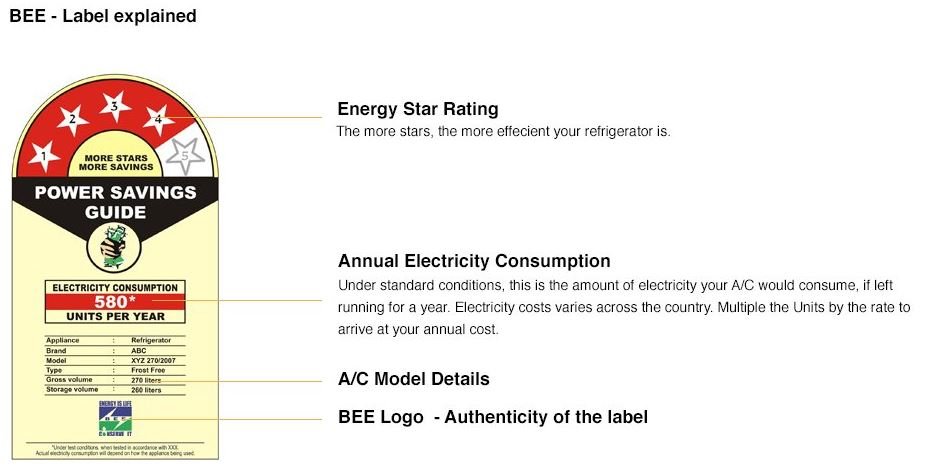
BEE Star Ratings
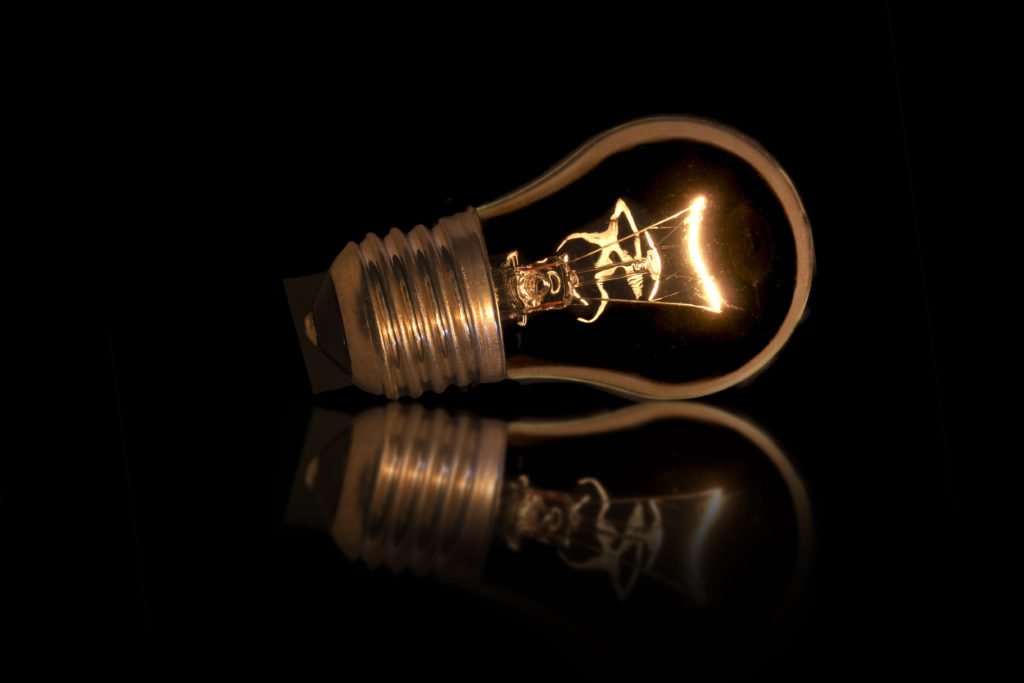
Edison Bulb
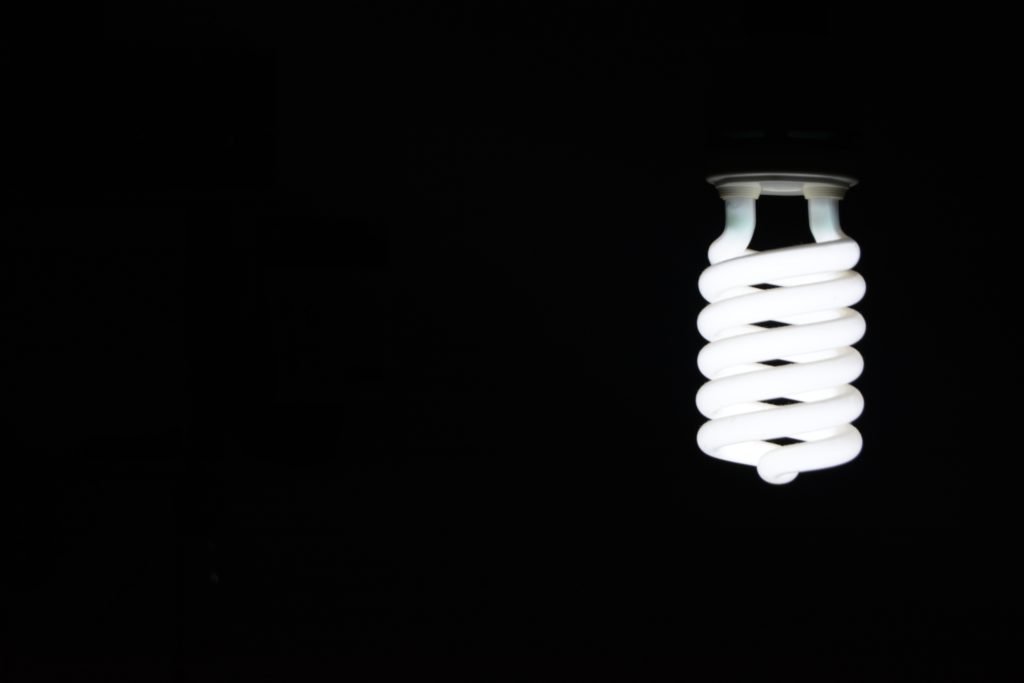
CFL
LED
Efficient light bulbs
To start with, use energy efficient light bulbs and appliances. The government has been promoting the purchase of CFL and LED (more of the later) instead of ordinary incandescent bulbs that most of the rural India still uses.
LED bulbs and lamps help in reduction of consumption while improving the brightness at the same time. Though a tad expensive, the cost benefit over the period is excellent!
Buy 5-star BEE rated products
In India, the government has enforced regulations that help understand how much a product consumes, thanks to Bureau of Energy Efficiency or BEE.
Among the mandatory product types to carry the BEE Energy Star ratings are Television, Air Conditioners, Tube Lamps, Refrigerators, and Geysers. Other’s are optional. So what should you do? Yes, buy the product that offers a 5-star rating. No less!
I firmly believe that all electronic products should mandatory carry the BEE Energy Star ratings. And 5-star rated products should cost less, which they do not. Lack of demand for costly product leads to companies not putting much effort into making them or making as much of them. We Indian’s prefer to go for the cheapest at the time of purchase, not considering the recurring cost (both financial and environmental) that we will be paying at the end of product’s life-cycle.
Switch off plugs when not in use
One of the things that we are often doing today is charging our mobile phones overnight. You can try and charge it before you go to sleep, or after you have got up. While doing so, do not forget to put the switch off.
A lot of offices work 24/5, and most of the times employees do not shut down the computer since they do not want to go through the pain of system booting up. It takes a few minutes to shut down your PC and start up the next day. But the energy it consumes in the meanwhile is a complete waste. Any equipment not in-use should be put off, including your WiFi connection.
3. Limit crackers/fireworks, avoid if possible
After the recently proposed ban on crackers during Diwali, we heard a massive uproar among aam aadmi, who immediately linked the ban to directly hitting their religious belief. Connecting the prohibition to religion was ridiculous; moreover, people went overboard with buying and bursting crackers just to oppose the move. Massive stupidity.
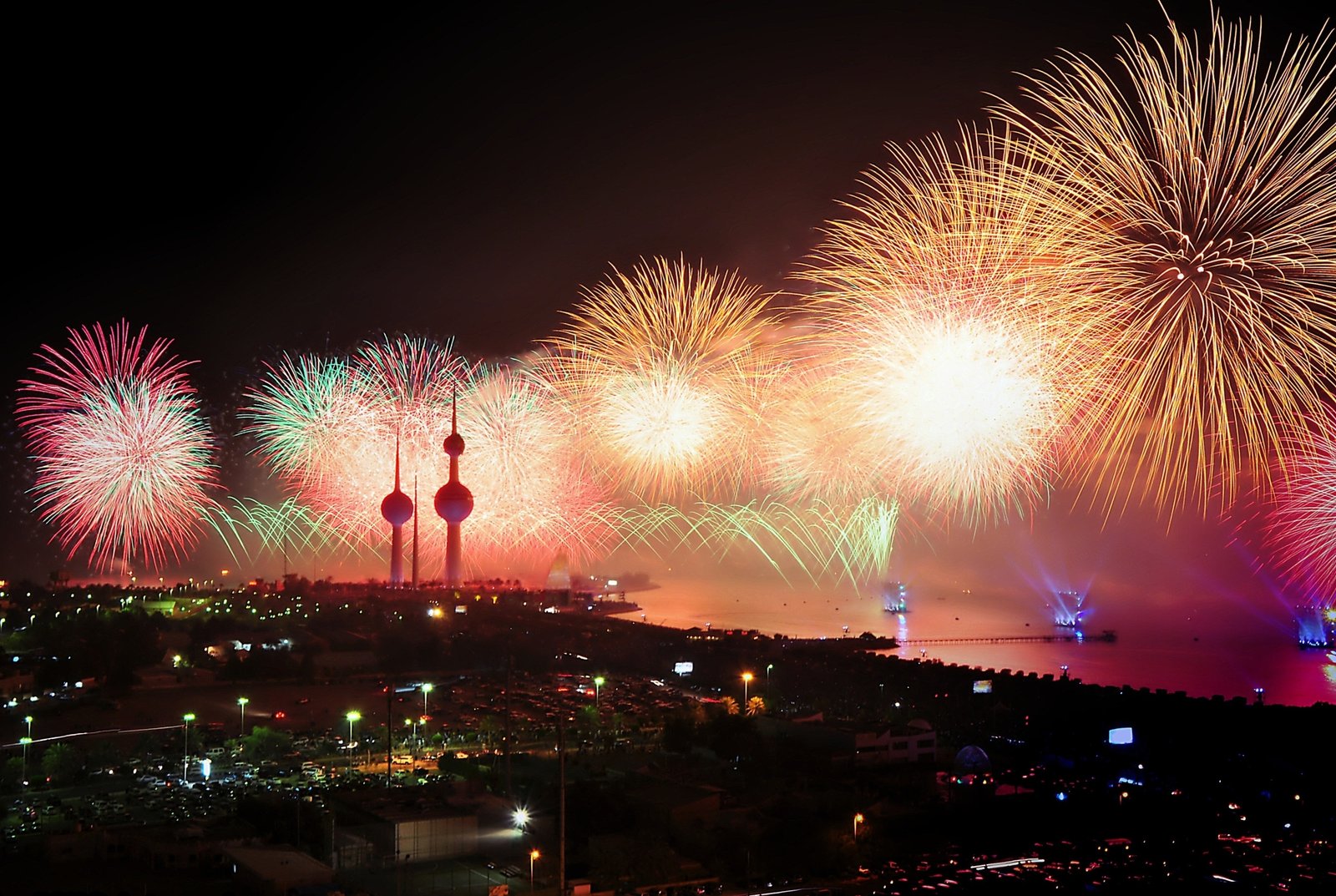
City night explosion firework
Crackers cause pollution at production, transportation and execution level. Not only it releases harmful toxins into the breathable air, but it also creates massive noise pollution, causing more breath-related diseases.
The solution is perhaps not banning crackers, but to limit it. Moreover, a government limit will only be symbolic at best. People will need to start realizing that everyone needs to control polluting the shared breathable air.
4. Carpooling, public transportation, biking and walking.
Carpool
One of the new trends across cities is car-pooling. It is supposed to be cool, and trendy, which it is. However, the reason we all carpool is to save on the fuel and not to reduce pollution or traffic congestions. While in a way, this makes sense, it would make you feel better if you remind yourself about saving the environment while you do so.
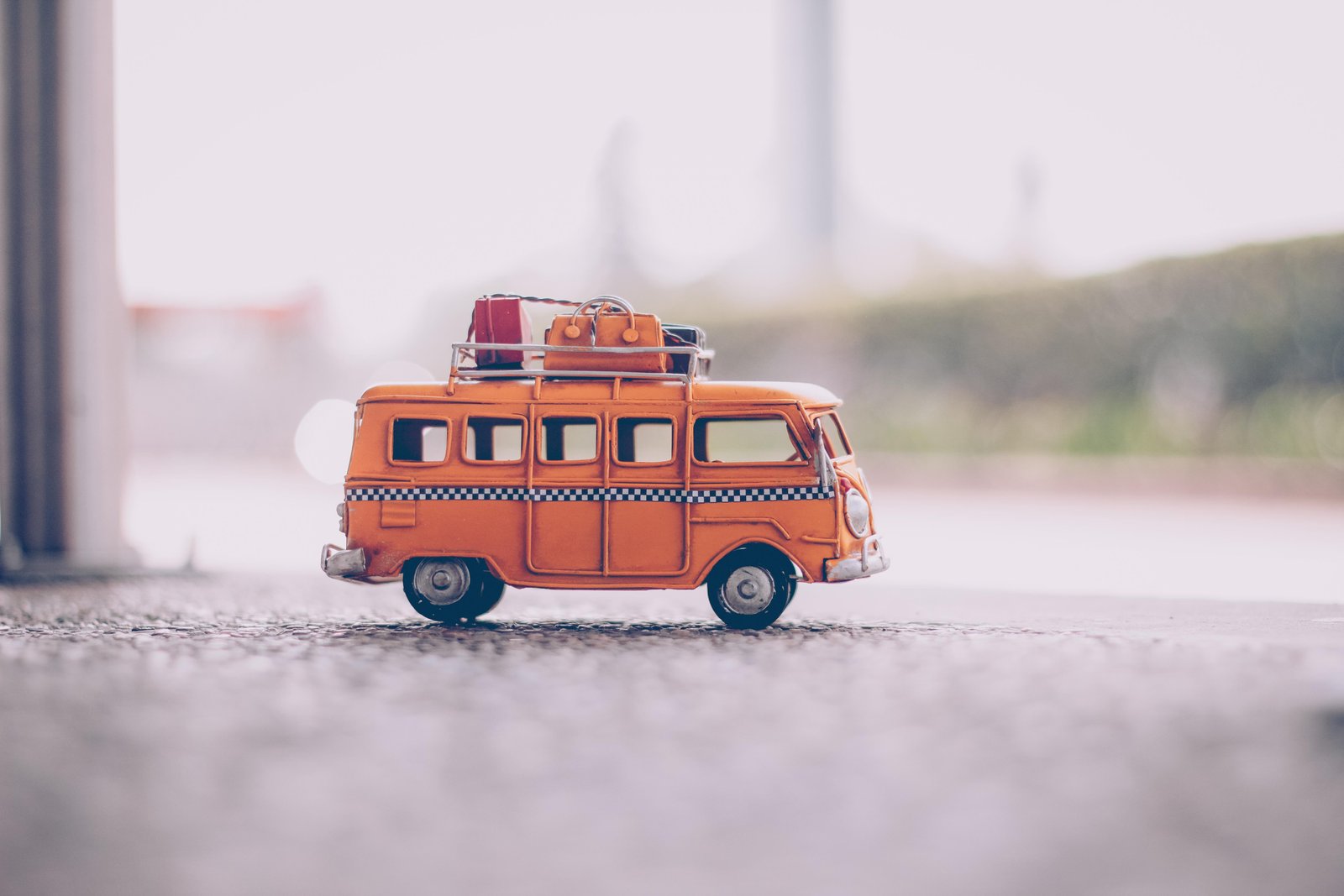
Transportation is as good as this at the best!
Public Transportation
I am sure we both agree, in India, public transportation is not up to the mark. It does not become a prominent choice because of the state of transportation and infrastructure. That part, our government needs to do. But once it has improved significantly, would you switch? Let me know in the comment section below if you would happily pledge to change!
Cycling and Walking
Most of us do not live nearby our workplaces. Hence, cycling or biking and walking are not viable options. But for those who do, switching to either helps in reducing congestion, pollution and improves the health of the individual.
India is far away from having its dedicated cycling lane. I hope it is sooner than later.
5. Regular maintenance of all machinery
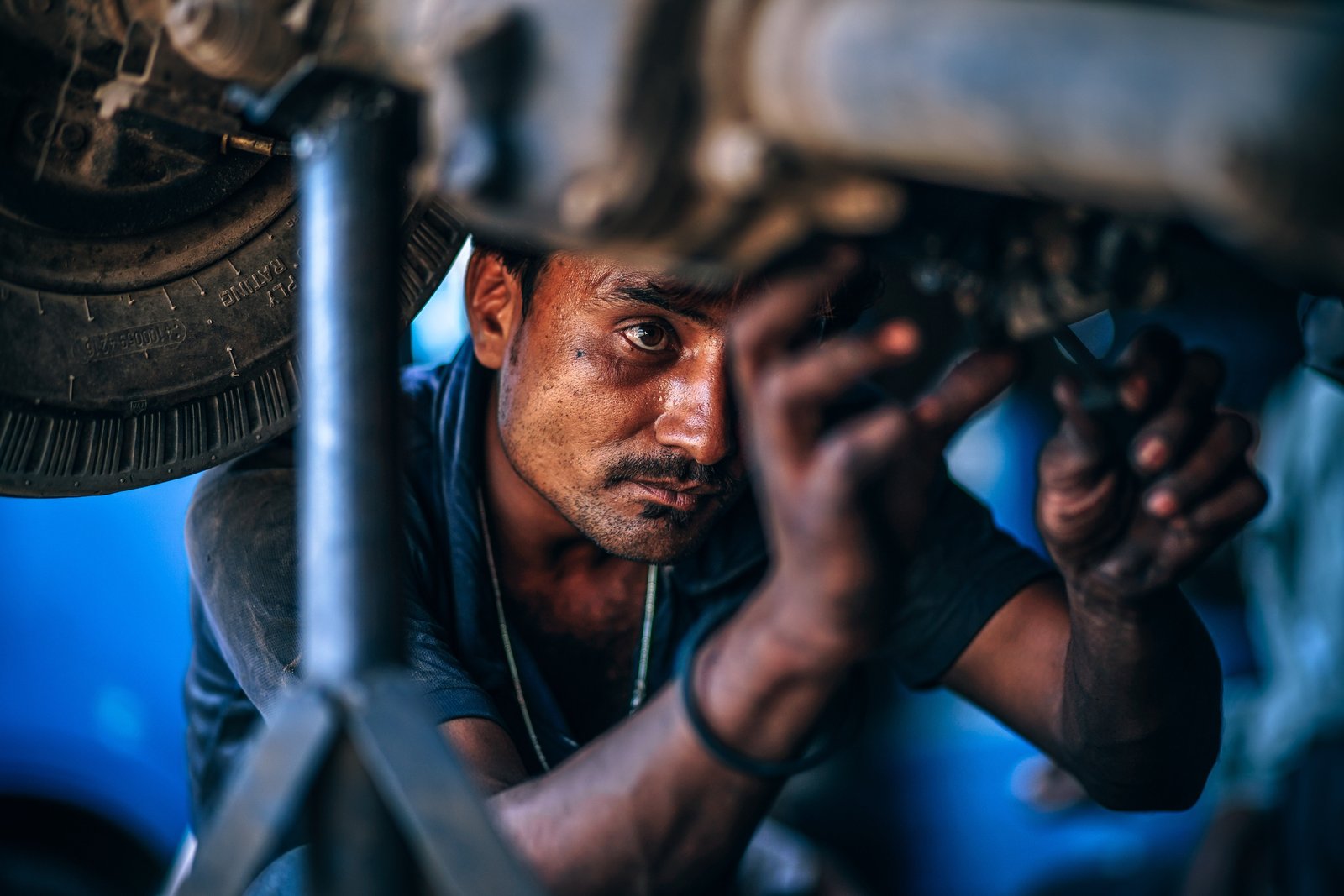
Keep your automobile, be it a car or motorbike, well tuned and maintained. Follow the manufacturer’s instructions on routine maintenance, such as changing the oil and filters, and checking tire pressure and wheel alignment. A well-maintained vehicle emits fewer toxins in the air.
In fact, you should maintain just about any machinery you use that consumes electricity or pollutant fuel. For your own and other’s sake, at least. Avoid excessive idling of your automobile. Shut the engine at signals and do not accelerate profoundly.
Maintenance of Vehicles is of paramount importance
6. Advocate for emission reductions
We are quick enough to protest the ban on crackers, but not as much when it matters to breathing polluted air. Thankfully, the government decided to skip the BSV or Bharat Stage Five level norms. It means by the year 2020, our standards at emission levels for new automobiles sold will be level with some of the European nations.
However, what people are not much aware of is the emission/pollution norms for factories and other establishments. Here is a link to the complete set of pollution control norms provided by the Central Pollution Control Board.
I have been posting videos on Indianomics TV since October last year. Starting with Tata Hexa review (very armature), I have now added 34 videos on various topics, predominantly Cars & Bikes.
Here is a playlist I have created with all of the best performing videos. Do not forget to like, share and subscribe to my YouTube channel.
Here is an overview of videos!
1. Tata Hexa Sound and Music System Review
Tata Hexa’s much touted audio system is awesome and among the best in a class even higher than where Hexa is positioned. The 10 JBL speakers produce clean sound that makes your ride enjoyable.
Song played in the video is Dada Dasse Re from movie Udta Punjab.
2. Tata Hexa Off Roading capabilities
Tata Hexa is an upcoming car from Tata Motors. The video here captures its off-roading capabilities using various drive mode and hill assist.
At invitation of Tata Motors, ~60 bloggers met in Delhi to review the all new Tata Tigor, the styleback car. Based on Tiago, Tigor is a compact sedan that looks absolutely great. The car looks stunning and had a lot of passerby interested in it! We even had a review on the fly from one of them!
‘This is not your normal review but an experience of Tigor Styleback event!
In this video, we drive from Aerocity in Delhi to Gurgaon in Tata Tigor Petrol and Diesel engined cars – en route visiting the Heritage Museum. My co-partners at the media drive were the gorgeous Dimpi Sanghvi and Venkatramana Manoharan
4. TATA TIGOR Acceleration – Indianomics
Tata Motor’s new Tigor will be launched on 29th of March. This video captures the acceleration of the Tigor petrol engine car that I drove from Delhi to Haryana.
5. A Day In Park with my die cast car models
I took out my small collection of die cast models of marquee cars and here is the result. Few nice pictures and videos that is fun. Though the video has not clocked as much views, I personally get a great satisfaction watching my die cast cars jumping and getting crazy at a children’s park near my place.
6. Why you should wear a helmet! Bhandardhara Accident live recording
PS: The date was not set on the cam, hence 2016. Incident happened on 24 June 2017.
Video taken by Shiv Vishwakarma, my friend who rode with us to Bhandardhara. We had stopped at a location where I had shot video previously, exactly when we saw this accident happen on the curve ahead.
A Hero Honda CD 100 was hit by Red Maruti WagonR who took a long turn. Both were to blame, primary though was the Wagon R who took the wrong side. The biker was not wearing a helmet (common across in the rural side, like this one) and had his headphone on.
It did not appear that his outer injuries were life-threatening, with no way we could identify inner impact. We stopped a few vehicles but no one was interested in helping. After about 4-5 mins, a small pick up truck came by and agreed to help take him to the nearest hospital. We ensured the driver of WagonR, an old man, accompany him to the hospital as well.
The video was shot last year by Tata Hexa team! All credits to Tata Motors to get out all the blogger videos out on their YouTube Channel. I do not know WHY I NEVER SAW THIS! They uploaded them two months after the event, may be that is why? Haha… here is uploading it on my channel for all my subscribers to see.
They got my blog name wrong! The URL shown in the video is pre-2009 domain blog and I wonder from where they got it.
8. Mumbai to Kerala on Himalayan and Dominar – Road trip to God’s Own Country
So my fellow TGW wolf, Tyjo Thomas got 7 days off on a short notice. He decided to go on a solo ride to Kerala and back. When he shared it with us, I was quick to decide that I should go along. Thus, with 3 days to go, I started my prep for the ride.
Subscribe to the channel, click on the bell button so you are among the first ones to watch them!
Write up of this part of the video, Mumbai to Kerala, is now available at my blog. It has in very detail, the entire route plan and our experiences. Music Credits: https://www.bensound.com
9. Mumbai – Kerala – Mumbai: A Photo Journey
Pictures from our recent road trip to Kerala by Hemal and Tyjo on Himalayan and Dominar. Route map and other details are in the follow up video, including the epic Wayanad Choram
I always wanted to go to Kerala on a bike and never thought I will ever do it, though I still wished I could. I had created many plans for a ride but was always quick enough to drop it. It always seemed like a distant dream that I felt I lacked enough guts to achieve. The last year has been challenging one for me in many ways, and my current situation only accentuates the impossibility of me undertaking such a ride.
My friend and a fellow wolf from Throttle Gun Wolves, Tyjo decided to go on a solo trip to Kerala on his Dominar. It was a quick decision on his part, and he was leaving on the third day, from the day he informed me. I decided to join him in his plan and make a lemonade of the lemons life threw at me. More the merrier!
Is there a video of this ride?
Yes, there is one you can watch. Head over to Indianomics TV channel on YouTube. Also, do not forget to subscribe to the channel so that YouTube can inform you of my next video.
There is another video of our pictures from the ride, which I had compiled and posted on the Indianomics YouTube channel if you would like to see some of these photos.
Preparing for the ride to Kerala
The next day both Himalayan and Dominar visited the service center and the day after I pimped up my Yeti. The typical, aux lights, a rear strobe light, and a phone holder with UBS charging port. I also got an SMK Twister helmet, replacing my aging LS2, and included a Bluetooth headset so that I can be in touch with my 3-year-old daughter and listen to the maps aunty barking directions.
Route from Mumbai to Kerala
Both Tyjo Thomas and I had different destinations – I wanted to go to Alleppey, my hometown and Tyjo wanted to go up to Kanyakumari. However, we always doubted if his family in Chalakudy will let him go there. Tyjo ended up touring places around Chalakudy, including the famous Athirapally waterfalls.
Our rides – motor bikes
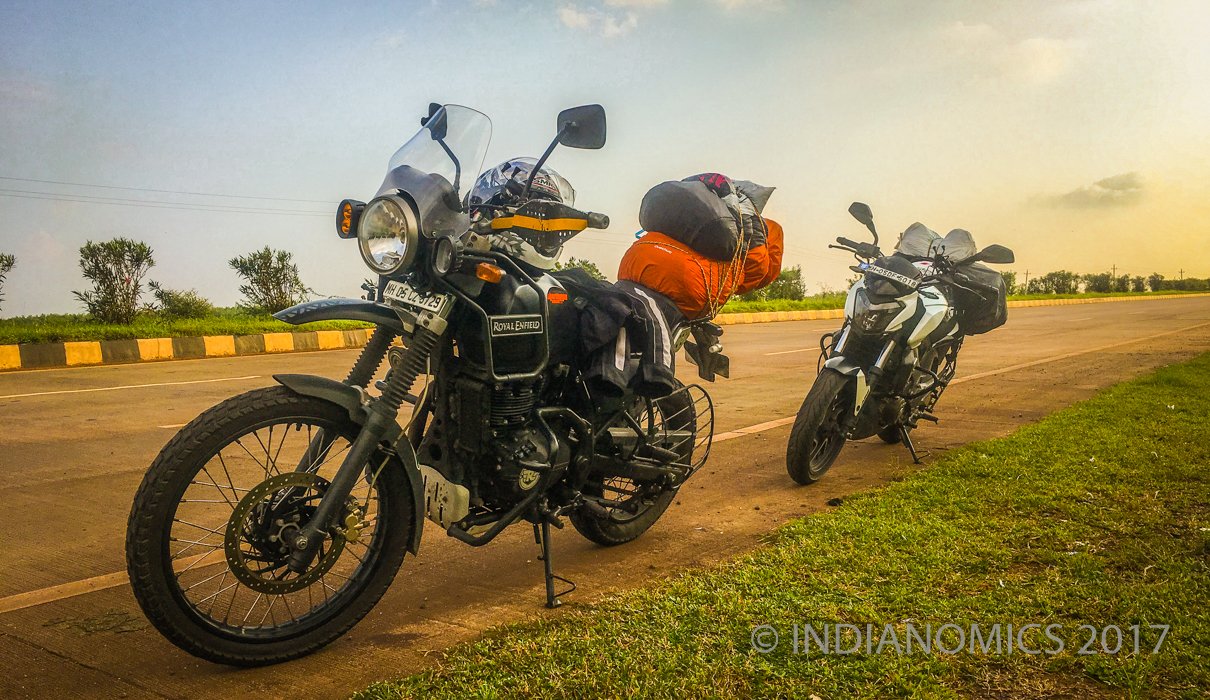
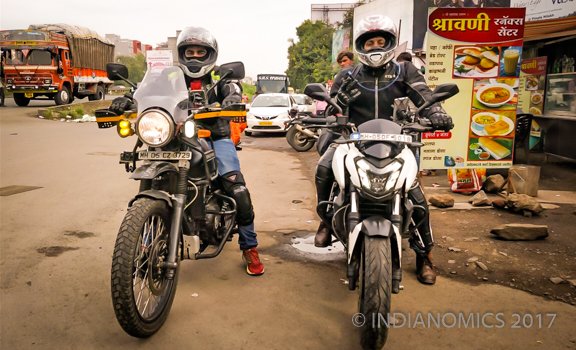
Tyjo Thomas owns a Bajaj Dominar 400 that he got some months ago. Dominar 400, based on the KTM390, heavily modified for cursing comfort and mild on-road manners by Bajaj. It is a bike that has potential to challenge Royal Enfield’s rule in this 350+ CC segment.
I own a Royal Enfield Himalayan. If you are regular here, then I am sure you will know about it. I call the Himalayan as Yeti, and there are tons of things I have already spoken about my bike.
Riding rules
We were clear on a few things before the ride started.
We will not be riding in the night, though start as early as possible in the mornings.
Do approximately 600 to 650 kilometers a day at the max, which ensured we are not too tired and have enough flexibility to take longer breaks.
Ride consistent speeds averaging around 80-90 KMPH
Spend money on only absolute necessity.
PS: We did break one law though, by riding on the Mumbai Pune expressway.
Capturing the beauty
We met another wolf Nikhil Deshmukh who helped arrange for two SJCAMs on loan, for us to record our trip, which was a huge favor that he did for us – for you can see in the video, we managed to capture a few clips that left us in awe. After the ride, my daughter has seen these videos again and again, and I love it every time it throws a smile on her face.
Two SJCAMs – thanks to Nikhil
One Sunco Cam – thanks to Shiv, though I could not use it as a backup camera throughout my trip due to a faulty memory card
My beloved iPhone 6s, Lumia 950XL
Prepping our bikes
Given that this is the longest ride I have done, it was imperative that I take Yeti to the service center for a thorough check-up. I was close to my 4th service anyways, so decided to go ahead and do it as well. Royal Enfield’s Pooja Motors service center immediately prioritized my servicing request, since the ride was just two days away.
Likewise, Tyjo also got his Dominar serviced the previous day. Given his tight work schedule, he did not have the liberty to get things done as I did.
After the servicing was done, armed with a new magneto coil replaced voluntarily by the SC, I took the bike to pimp it up a bit the next day. I needed fog lamps installed on Yeti, just in case we need to ride in the dark. My focus was to ensure that I am not distracting the drivers/riders from the opposite side, but make sure I am visible enough.
Thankfully, I got a fog lamp and led white light combination (which I had secretly wished) because the store did not have two fog lamp units readily available. I also upgraded my helmet to an SMK Twister (with a Bluetooth headset) from my existing LS2 (I lost my brand new SOL Infiniti a few months ago in an impossible way) and got a knee guard, something I never had before. I will shortly write up a review of my brand new helmet and how much it helped me during this ride.
Bluetooth headset served two purposes; one, since we relied on maps massively, it was easy to ignore looking into the screen all the time to check if we need to change direction. And two, it helped me be in touch with my daughter without removing my helmet.
What we packed?
Tyjo had got a tail bag, and I got my Wildcraft trekking bag, and a backpack. Both of us carried sleeping bags as we had anticipated sleeping in places that would cost us almost nothing. Even though, we never used them as we managed to find places to stay within our affordable reach.
We carried underwears for seven days and enough tee-shirts, jeans, and shorts to last us three days. We knew we had the opportunity to wash them once we reach our respective destinations.
Both bikes did not have saddle stays, and hence no saddle bags. I packed my backpack with essentials I would need, including my laptop and a backup phone. Based on Tyjo’s experience, we also picked up two dozen of Snikkers for quick bite if required (ended up sharing and eating it with families)
And for the bikes?
For the bikes, I had carried an entire set of Allen key, screwdrivers, and spanners. Tyjo did likewise, though he got his set of Allen keys from Nikhil. We also got a breakdown rope in bright orange from Nikhil, just in case we face some difficulty.
Tyjo also carried a chain spray, and both of us used it. I inadvertently forgot to take RE Chain spray can I had at home. They say at every 500 kms, we should spray the chain and clean it, which we did. I did face issues with the Himalayan, but that will be an individual article, the link you will find here in future.
Day one – Mumbai to Hubbali (Hubli)
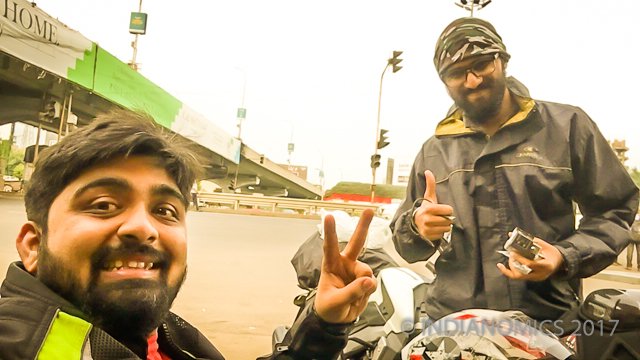
We set to ride early in the morning from our respective places at 5.30 am. The bad patches towards Panvel, and the traffic + chaos it caused delayed us a lot. We also did something spectacular though, something we should not have done. We took the Mumbai Pune Expressway after Lonavala. I know, we should not have. Primarily due to map directions (forgot to switch off tolls) and then neither of us ever rode to Pune on a bike before.
Breakfast
We stopped at Pune for a healthy Puneri meal. TGW Wolf Nikhil Deshmukh rode down to meet us and hand over two SJCAMs. Very crucial for our trip, we guessed. As the video shows, it sure was a brilliant idea.
I did carry cam from my friend Shiv, a Sunoco. However, it was my backup in case the SJCAM lost steam or if Nikhil could not manage it for me. After having our breakfast and a quick camera set on Yeti, we were ready to ride. Tyjo forgot to get 3M tape for his helmet mount (again, something that Nikhil got for him), and hence we decided to proceed hoping to buy one at Hubbali.
Kerala Ride to the god’s own country
Kerala Ride to the god’s own country
Kerala Ride to the god’s own country
Kerala Ride to the god’s own country
Kerala Ride to the god’s own country
We rode towards Hubli via Kolhapur. After the initial hiccup in the traffic at Pune, we were soon riding the empty roads. The best section this side of our route was the Satara Ghats. The three-lane ghat roads were super comfortable with traffic, and I could almost corner my Yeti with my knees almost touching the tarmac.
Unfortunately, for a reason unknown, the SJCAM stopped working after I took the first corner – and hence, could not see how I took the rest of them.
Lunch at Jai Hind
We were on time as per our route plan and reached Kolhapur around 1.30 pm and stopped for lunch. And here is where we encountered one of our exceptional hospitality experience in this whole trip at the hotel named Jai Hind, which is off the highway.
Honestly, we were tired. And, yes I forgot to do a lot of things – like asking the guy his name or taking a picture. We were too focused on riding and getting to our destination for the day in time.
As soon as we entered the hotel, this guy (must be around 45, sports an orange beard) escorts us to a place where we can keep all our unmounted luggage. He directs us to the washroom, then to the handwashing area and then asks us to take a breath and think of what we want to eat.
This guy goes about suggesting what is the best that he can offer considering we are riders. He hints on little rice and more of vegetables and egg. We stick to the later, as rice tends to make us sleepy in our routine lives.
Food was nothing to write home about and was average at best. However, the best was yet to come. Tyjo candidly asked if we can rest on our backs on the chairs – and immediately the answer; sleep till evening if you so wish.
The masala tea story
With our backs on the chair and looking up at the ceiling, Tyjo wonders if we should drink tea. I inquire about it. This guy (I seriously am feeling sad not to have asked his name) is quick to say that you will not get the tea as we get in Mumbai.
I prod him for masala tea, instead. Or ginger tea. Of course, they do not serve it there. Not one of the regular requests in this part of the country. After a while of resting when we were about to make our move (oh yes, we forgot about the tea) is when the tea comes in.
And yes, it is masala tea with ginger! We could not believe it, and that brew was fantastic. From expecting a plain tea to forgetting all about it, and then to have this guy deliver what we hoped for – that never was available at first place. The bill was a total of Rs. 260/- for a service that was close to a 7-star treatment for us in pure Hindi!
Do not have words to explain. I will leave it at that.
Stay at Hubbali
We moved ahead towards Hubli. The roads were pretty neat, and we could make it to Hubli in time as per our schedule. 6.30 pm, touch the city. Looking for the place turned out to be tricky, as Maps kept redirecting us. And finally, we made it to Kutchi Bhavan.
Thanks to my friend Jiggu whom I met after 13 long years, we had room to put our heads down. Jignesh also helped us get 3M tapes from Hubli market, and played host to an excellent dinner along with his wife, Darshana. It was my first time meeting her, perhaps not the best impression I could cast!
Day two – Hubbali to Wayanad
Next day, we left early in the morning at 6.00 am, instead of planned 4.30 am! Here on, unfortunately, we did stick to this routine and made it worse. More about that in the text about coming days. The exit was easy from Hubli, and soon we were doing 120 kmph on the empty stretches of highway. Around 8.30 am, we stopped to fill our bellies.
The breakfast cheat
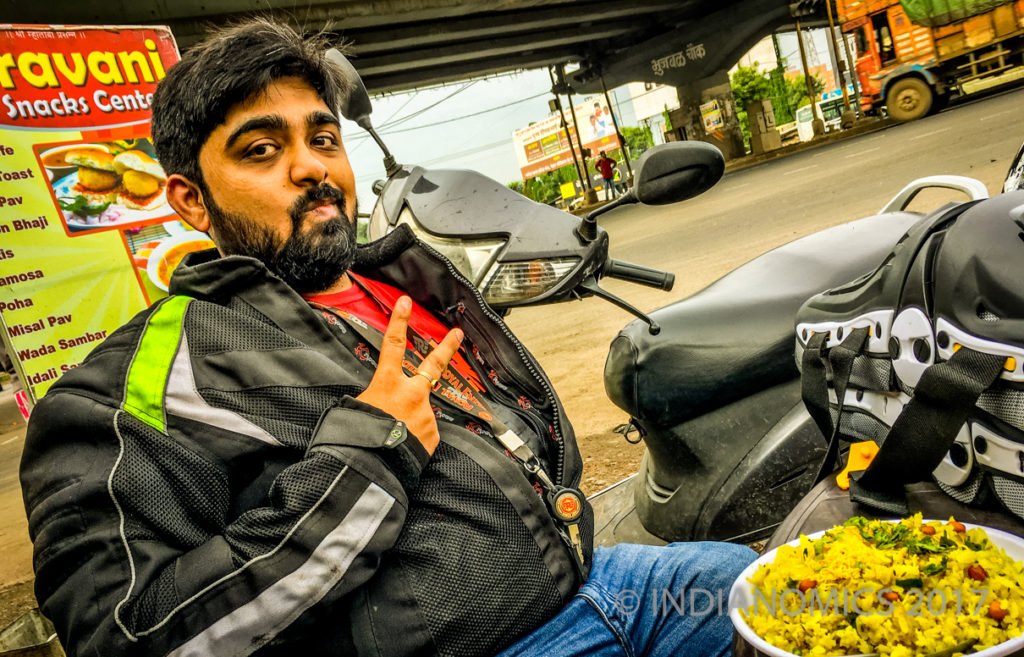
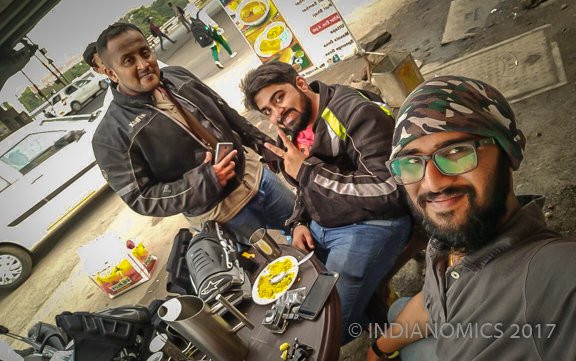
On this ride to Kerala, we forgot we were in Karnataka till we asked for the bill for our meal. Breakfast at a roadside shop next to the second toll booth on our way ended up paying Rs. 280. A meal that should not have cost us more than 100 rupees at a premium. We paid less for an excellent service plus lunch at Kolhapur the previous day. The shopkeeper realized that we weren’t from here, and may have thought that we were riding expensive bikes (well, in a way) so why not ask for the money he wished?
Our mistake? Yes, a big one at that. We did not ask for the price of what we were ordering – so the shopkeeper was free to quote whatever he felt (80 rupees for two liters of bottled water). This place is not a proper hotel, and I am talking about just a roadside shanty shop.
When in Karnataka, always ask for the price first. We decided not to engage in a war of words in a place we did not know the local language to speak. It was not that much worth a risk, given that the area was mostly empty.
Lunch at a Sisidi!
We stopped for lunch at Cafe Coffee Day outlet near a petrol bunk, and that is when I checked my WhatsApp which left a jolt. We need to make it to the entrance of Bandipur National Park before 6 pm. The entry time was not part of our plan – and something that we should not have missed! Darn, if we knew, we would have been a bit less relaxed.
Again, thanks to Nikhil who was informed by Rahil, as he had passed through the area couple of days ago – else we will not be let through the forest area. Suddenly, there was a panic, and we were drifting through plans of what to do in case we don’t make it.
The best option to consider, was to divert to Ooty, though this will mean we will be riding through the mountain in pitch dark. Also, an expensive proposition.
However, soon I realized that we can still make the entrance and we were calculating the estimated time to reach Wayanad as beyond 7 pm, and hence confusing it with entry time at Bandipur which we can approach one and half hour prior.
Bandipur National Park
We gunned the bikes given that the roads and highways were smooth in Karnataka, and were relatively empty. Hardly we faced any traffic on N.H. 48 or other diversions we undertook. We made it to the entry gate to Bandipur National Park by 5.30 pm!!! Hallelujah.
A sigh of relief, both of us stopped to switch on our cameras so we can capture the ride through the jungle. It is in the evenings that elephant herds move across the roads. In the night, the numbers shoot up like crazy, and it is practically impossible to drive or ride through. Let alone; you encounter their wilder side.
It is fascinating to ride through the jungle, with smooth roads. Speed breakers help you slow down. No, not for animals to make you their easy dinner (or play toy if its an elephant), but to stop you from killing them.
As we progressed through, I was lucky enough to miss an elephant crossing by a whisker. I mean like if there was a 2-3 seconds delay and I would have hit an elephant or vice versa. You can see in the video, how close I was! That was perhaps my first encounter with wild animals in the jungle. Of course, I have seen and touched and ridden atop an elephant, all of them were domesticated. So this did send chills down my spine for a few minutes.
Entering the lustfully green Wayanad
In a little while, we knew we were in Kerala – as it started raining heavily (pun intended). From then on, it is a drenched ride! While in the middle of the forest, it started raining. We stopped at the end of the woods, completely drenched, to get our hands on a hot glass of Kerala tea and wait for the storm to pass. It also played its part in delaying us further, as we could not speed up in the twitchy roads (ghats) of Wayand. With no luck on our hopes, we started riding towards my friend Dijosh’s house in Wayanad.
By the time we reached our destination, it was already 7.30 in the evening. It took us another 30-40 mins to unload the bags and remove our safety jackets and knee guards. A hot bath helped refresh us a lot, and the steamy dinner just added to our delight.
Day three – ride to our final destinations in Kerala
I cannot thank Dijosh and his family enough for taking care of us like we are kids. Dijosh and I have been good friends since 2005, and our families know each other well. Tyjo and I ate to our heart’s content the homemade delicacies that both of us always yearned!
The dinner and the early morning breakfast were a feast. The morning meal reveals a ritual unknown to both of us (I am brought up in Kerala, Tyjo is a born Malayali) of eating Puttum Kadalayum with the fabulous Kerala Papadom. I never imagined it before and will ensure I do it every time I am eating Puttum Kadalayum. Loved it that much!
Dijosh and his father escorted us through Wayanad in his brand new Skoda Rapid and visited the Pookode lake. Since we left at 7.30 am, the access gate to the lake was not open yet. We roamed around the roads on the lake bank and turned around to move from Wayanad. Got our luggage from the car, and off we went, saying our goodbyes to our wonderful hosts!
Thamarasherry Churam, Wayanad Dist., Kerala
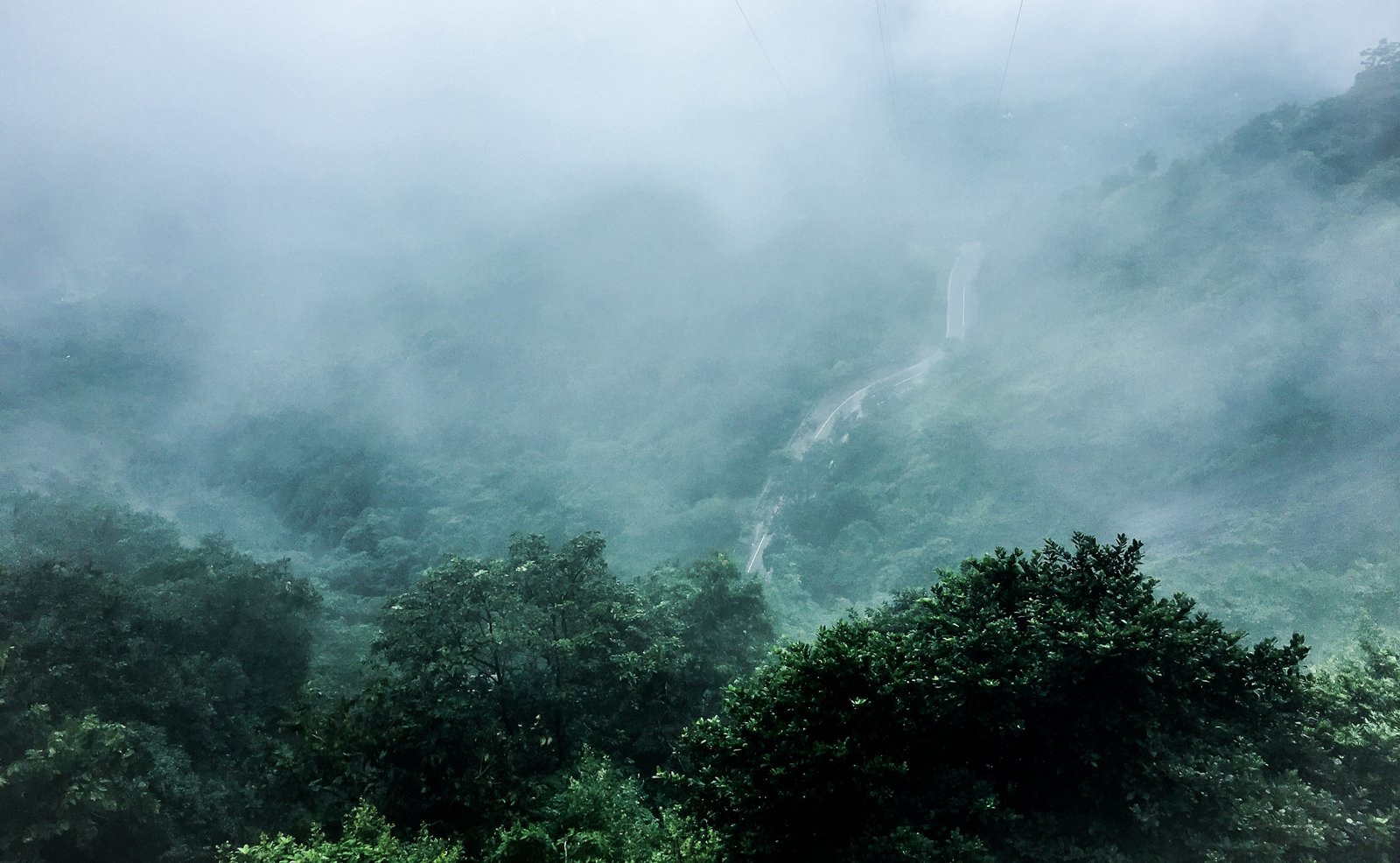
The moment of madness was to ride via the Thamarasherry Choram – the nine hairpin scenic beauty. During the plan for this ride, Tyjo made it clear that we travel through Wayanad to enter Kerala. Unaware of the extravaganza, our experience at the Churam was wholly impressive. Tyjo had his fill of the beauty of Wayanad, and it is pretty evident from his expression captured with the camera. Hear it in the video posted above. It was perhaps our best ride experience in Kerala.
Wayanad is beautiful, and if you ever get a chance, do visit. Ride from Wayanad to Alleppey was about 300 kms; however, the dangerous condition of roads and the disobedient traffic made it difficult for us to travel. We struggled through Mallapuram and the outskirts of Calicut (Kozhikode) to ride through.
60KMPH Limits
Kerala has the stricter speed limit implementation with speed cameras installed across many of the highway spots. They take a picture of you speeding and courier you a ticket at home. I would not know it anytime soon if the authorities decided to send me one as well, as this takes typically anywhere between one to four months.
We did exceed limits, however not by much. With 5th gear engaged at 60kmph on my RE Himalayan, I could not continuously ride at that speed. It caused unwanted (because I was exhausted) vibrations, which are standard.
Especially after Tyjo and I parted ways, I tried to keep it between 65 and 70 kmph. And at times when I overtake vehicles (many cars too are driven at 60-70 most of the times), I touch 80 kmph. I saw a couple of manned speed guns while doing those speeds but no one stopped me (well, through our entire ride no one stopped us!).
Here is hoping that the guys behind the screens have ignored my peevishly exceeded speed limits.
The traditional Kerala Sadhya for lunch
By noon, we stopped for lunch somewhere in the Thrissur district. It is hard to spot a restaurant that was operating in this area – which did surprise us. The rare one’s we was too crowded for us. Also, the fact that we had to decide whether or not to unload our bags from the bikes mattered in the decision. So hungry as hell, we decided to chance upon the next available place that sold food.
Thus we reached a small, roadside hotel. Eating excellent food, both I and Tyjo were having a blast enjoying the traditional recipes. Tyjo preferred to gorge on the beef dishes, which he missed since the beef ban in Maharashtra. I stuck to my vegetarian stuff – the famous Kerala Sadhya.
The food was delicious, and cheap, as we only spent Rs. 120 for a fulfilling lunch.
The ruined surprise!
My parents and family back in Kerala did not know I was coming! Yes, I did successfully hide that fact. Up until Thrissur, that is. I called up my aunt (dad’s younger sister) to let her know that I was coming and asked her to reach home as well. While I did tell her that it was a surprise, but I guess she didn’t get the right memo. My short-tempered father received me with his anger later!!!
Riding ahead and parting ways
Tyjo and I parted our ways at Thrissur bypass for our respective destinations. We stopped, bid adieu to each other with the promise that we will be in touch soon. Tyjo had already gulped the fact that his family in Chalakuddy is not going to let him ride further south to Varkala and Kanyakumari given the limited time he will be spending with them.
Solo ride to Alleppey
There on, I was riding solo, perhaps the longest solo ride I ever did. Riding through Ernakulam and Aluva was a nightmare due to traffic. The metro seems to have made the traffic situation worse, though I saw little traffic aggression at the lights. Almost everyone was halting before the white line. No cramming of cars and bikes into any space available – it is a departure from what we see in Mumbai-Thane belt. Roads in this part of Kerala are clean and pothole free and enjoyable otherwise.
Soon, I was in familiar territory. I was riding through Aroor and Chertala, the roads that I have seen growing up. I did not need a map through this route, but the continued rain had drained me a lot. Exhausted, I took a break after Pathirapally to tank up and make a few calls.
Reaching my hometown!
As I approach my home, which is just five kms away, I face one of the worst traffic on this route. Cars and trucks hardly moved, and this when I decided to use my Himalayan’s off-road abilities. Riding through knee-deep, filled-with-mud potholes on the side of the road to get rid of the traffic and rush home.
Finally, I reached the place where I grew up, the place that is still living in the 20th century. I passed by my alma mater, Leo XIII H.S.S. and suddenly the fond memories of childhood flashed through, occasionally interrupted by the speed bumps and potholes.
Sure enough, my father was waiting for me – wondering where I was and why I decided to ride a bike all the way to Alleppey. Of course, for family, safety and security of their kids are paramount. Of course, the most substantial portion of the older generation will never understand this stupidity (for them, at least).
Finally, I was home!
Further reading
The write up to the return leg is in the works, so is the ride experience on Himalayan and Dominar. Be sure to visit again in a week’s time to see more of our adventurous ride to Kerala.
Hey, people! The site you are browsing now is secure now with a Secure Sockets Layer or SSL that encrypts the data that will transfer between the hosting server of my site and your computer or mobile device.
What does this mean?
It was not common place to get a certificate for a website that is not indulging in a financial transaction till a year ago. However, of late, there seems to be an upswing to this trend. Browsers detect any physical input by the user as an interaction, be it a comment or using a contact form.
Hence, it has become imperatives that some day soon, every website will need to be encrypted. Sooner, the better.
Mine is just a blog, so do I need to have an SSL too?
See, Google pretty much controls most of the means of access to an internet site. Be it with the browser, mobile or search engine. More than 90% of the people who access internet use Google in some form of another. That does scare a lot of us, yet it also helps Google to dictate terms.
Both Apple (Safari) and Google will soon start informing users on sites that are not secure. To start with, Google will warn users when they are in the Incognito mode or private browsing. If you have any forms (comments are forms) running on your website, then Apple and Google will require you to be HTTPS secure. Failing to have an SSL will prompt the browser to issue a warning to the user.
Now, you need to have a really smart user to identify if the warning is unnecessary or she/he would want to stop in their tracks and not access your blog! In the days and times of internet where hacking a website is simple, for an alert user, a subtle warning can stop him in his tracks and rethink if he wants to hit the site or close the window.
I am sure all Indians know of the demonetization move by the Government of India. There was a huge ruckus on the streets as ATMs ran out of cash. So many wasted productive hours in queuing up for the much-needed cash to go through about their lives. In one swift move. Life has changed.
Comedian Kunal Kamra explains the situation is the aptest manner in this video here. Before this government came into power, one of the most profound campaign subjects was corruption and Swiss bank money. The promise of taking money from Swiss bank accounts of Indians and distributing them to every Indian citizen was too firm. Alas, we saw nothing of it.
Demonetization Impact
For obvious reasons, demonetization is one of the most talked about subject in the last six months. There is so much written about it, that finding my blog via a regular Google Search is hard. Of course, the government cannot accept it, even though it is morally obligated to accept something that goes wrong.
Sure, the impact was greatly felt by the common man. The same ones that Government was trying to protect and improve his livelihood. Being the large cash economy that we are, it is hard to live without currency. The merchants insisted on getting money in currency notes, and the onus was on us.
The digital currency that exists is, even today not preferred by retailers. I went to a hardware store the other day to buy RCB socket costing Rs. 1900. I asked him to take debit or credit card and he immediately said that I would have to pay 2% services charge.
I declined to pay 2% extra, and he asked to pay in cash. All other shops were charging me Rs. 2100 for the same product. I had little choice. So I went back to the shop and just by chance asked if he accepted Paytm. He said yes, and he won’t charge 2% extra. I paid from Paytm. For me, it is digital money. I don’t know how he is converting his digital money in PayTM.
He can pay his electricity bill from PayTM for no charge and would avoid paying tax on that income. He can transfer PayTM money to other numbers and stay below 20,000₹ limit to ensure he doesn’t have to furnish KYC.
How has government assessed demonetization performance?
In an earlier statement made during a parliamentary session, the government stated that found about 11 crores worth of fake currency.
In a more recent report, Rs. 15.44 lakh crore in banned currency notes deposited in banks (99% of the amount circulated). The 1% loss is worth Rs. 16,000 crores. Well, that does not sound much of a relief then, does it? Many of the notes that never made it back may have severely damaged (floods could cause it). Lost in places not found in time to deposit in the bank (I have 20 notes of Rs. 1000 at my home in a piggy bank) and many kept it as a souvenir (I know I did before I found these 20 notes).
There is every chance that 0.5% of the currency bills that never made it back to the system, is genuinely lost. Or purposely held back, but not for avoiding taxes. Essentially, of the total, approximate of Rs. 8000 crores may be the black money.
Why this move to demonetize went wrong?
What was worse is that Government introduced new Rs. 2000 and Rs. 500 notes as replacements instead. This move killed the initiative. In the immediately following days after announcing the demonetization, police made many arrests, including politicians, for hoarding the newly launched Rs. 2000 currency bill – when people were dying in queues to get even one. How did that happen? And who is to be blamed for it?
Instead, the government should have printed more of Rs. 100 notes and pushed people to go digital. It would have made people take up the digital mode of payment and stop using currency for all bulk transactions. All of the hawala transactions would have to be carried out at higher risk because of the volume of the notes they would need to bring.
Many people were allowed to submit up to 1 lac without attracting an investigation into their accounts by the Income Tax department. The government also invited those tax evaders to declare their income, pay taxes and convert their black money into white. While these did help a bit in collecting taxes from a certain number of people, these are such small amounts that government has not come forth with any figures. Rather, they have generalized that tax collections have improved.
It did have an impact on terror funding, but only till the time more currency notes were available. The tension in Jammu & Kashmir is still prevalent. The move helped banks by bringing in cash into the banking system, and therefore lowering the cost of loans – benefiting both citizens and banks alike. But at what cost?
And what about today, almost ten months after this monstrous (the size) move, we are yet nowhere near eradicating of practices the demonetization was intended to achieve. Merchants still insist on selling goods without a bill, transact in cash and charge an additional surcharge.
Skewed Taxation
GST has further complicated matters, and its implementation has been sketchy. We, the common man, have not felt the impact of GST yet. The prices of products are still the same; numerous examples have surfaced where restaurants, who do not even have a GSTIN, charged GST on customer’s bills! There is rampant profiteering by many merchants, and still, Government is busy defending itself from the demonetization debacle.
As such, tax collection in India was always skewed and was never effective. Four industrial states make a lot more money in taxes and almost bear the brunt of getting far less in return. Here is an overview of a Bloomberg Quint report.
Bloomberg Quint – Devolution By Centre To Average Resident of Each State
Bloomberg Quint – For Every Rs 100 Given By Each Resident To The Centre
Bloomberg Quint – Per Capita Contribution To Central Taxes By State
The government has many steps to take to ensure that tax evading is not happening. Demonetization has in a way helped, with the new Rs. 2000 currency bill.
Do I fail to understand, as an ordinary man, why all this has happened? No, I don’t. Learnings from similar moves taken place in many countries never taken into consideration? Good intentions are welcome, but converting them into actions is the need of the hour.
Share your thoughts with me in the below comments section. Do you think it was demonetization or demon-ization of the Indian economy?
For those who know me, also know that I ended up marrying a stranger I met during the floods of 2005 in Mumbai. It was a dark day, for many who lost lives of loved ones and a livelihood. Some passed away in extremely precarious circumstances, completely avoidable. I have often wondered why Mumbai has this strange connection with floods and rain?
Sure, floods or any other natural or human-made calamity has always brought the citizens together. The bond of a Mumbaikar is seen, often during such unfortunate circumstances. The never dying, ever famous Spirit of Mumbai!
Does Mumbai hate rain because of floods?
For starters, no Mumbaikar’s do not hate rain. Not because of anything to do with rain itself. It is, because of how city transforms itself into after a heavy rain. Choc-a-block traffic snarls, back breaking potholes, speed breakers and general public tendency to skip following rules. The last bit is people’s making, and that gets amplified when they need to get home as soon as possible given the situation. Rather, unfortunate.
Mumbai attracts rain, and it is often bad and sometimes ends up in floods. The sub-urban railway system or the local train is always under stress during rains. Huge delays in train services are common place when it rains heavily. Every year, BMC and other agencies that are supposed to do good work for the city, fail to do so. The most common excuse is the rain itself.
What it looked like?
A collection of videos and pictures shared over WhatsApp is compiled as under, to show you how a few hours of rain wrecks a havoc. Subscribe to my YouTube channel, Indianomics.
So why is Mumbai failing every time?
This year, Radio Jockey Malishka, released a song in a format that has been trending – “Mumbai tula BMC var bharosa nahi ka.” It invoked the ire of BMC’s ruling party members who came up with a response in the same format. It was pathetic, to say the least. It included slur, a threat and it came from a senior leader of the party. BMC also served Malishka’s mother a notice for breeding Mosquitoes at her apartment, as a result.
Mumbaikar’s spirit it unfathomable. They have come up to help themselves right in every instance there has been a natural or human made calamity. So in that sense, Mumbai has never failed. The people who are supposed to be managing Mumbai, the Brahin Municipal Corporation (BMC), India Meteorological Department (IMD) and many other have collectively failed over many times.
One of the things many of us who watched the movie Home Alone 3 have noticed how the little boy Alex lies to his mother about the terrible weather she is about to encounter so that he can drive her away from home. The American counterpart of IMD has always predicted the weather right. Well, at least in movies. Hence, the expectations that IMD comes up right are always up.
Is IMD responsible?
IMD has failed to predict the very heavy rains. They never were able to predict the floods in 2005, and not in 2017. Or anytime in between. The joke often goes like “If IMD says carry your Umbrella today, then you don’t need to because it rained yesterday.” The same thing happened on 29th of August, 2017. They issued an emergency alert for 30th of August, 2017 and stated that heavy to very heavy rains can be expected. It was largely a sunny day.
But they can only predict, not avert the disaster themselves and prepare us to expect weather conditions so we could decide to avoid it.
Floods can be avoided, should it not?
Of course. Else, why will a few of us be up in arms against this pathetic situation? If Mumbai roads can fail, ideally all of the highways near Mumbai should also meet the same fate. But they don’t. Potholes have made the roads miserable. The drive/ride is pathetic and bumpy. But hghways are smooth enough even after terrible monsoon season.
Garbage
Garbage collection is still worst at its best. The very Mumbaikar also contributes by throwing waste at all possible places including the sewage lines which clogs the exit of water into the sea. Prime Minister Modi’s Swacch Bharat Abhiyan has some effect, not significant enough to help Mumbaikar’s from themselves.
BMC makes a lot of money
Being the richest Civic body in India, BMC generates annual income in taxes and others fees to the tune of Rs. 37,000 crore. Seriously though, it’s hard to see where it went. Rs. 37,000 crore should have ensured futuristic mode of transportation for its citizens. Plus, Mumbai’s contribution to the direct tax (income tax) is also the highest in India by any city.
So where does the money go?
It is an interesting question; isn’t it? I have often been wondering the same thing. Most of it goes in corruption. There is an ambitious project to clean Mithi River (if you can call it a river indeed) every year, and we see hardly an impact. Well, there are encroachments alongside the bank of the rivers in many places which make it difficult to clean, the river also carries a lot of waste from all areas it flows.
The other problem is an issue that cannot be improved. Mumbai is originally 7 islands connected to each other by reclaiming lands on the sea in the mid-18th century. The Hornby Vellard project reshaped Bombay into its current form.
Add to that, lack of garbage dumping grounds does not make BMC efficient in its methods. The nexus is so strong that it is often difficult to fight them and sustain your life. If a Radio Jockey can get a notice served for breeding malaria causing mosquitoes at her house, anything can happen.
It is appalling that Mumbai gets this step motherly treatment then? Share this page with your friends and family! Share your thoughts in the comments section below.
Thanks to all the social media networks, you are not far from being reminded significance of the day. From crazy dates like 17/01/17 to 12/12/12, to important dates of note. One such day is today, the National Sports Day.
To the generation I belong, it is hard to remember Dhyan Chand. The legendary hockey player who made a mark for himself and our country everywhere we went. Hockey, being the national sport of India, has not take off as it should have thanks in part to cricket craze the country is under.
Men’s cricket overshadowed Hockey like the Clegane clan of Game of Thrones. And it makes a lot of money. Women’s Cricket, not so much. So why I am talking of Hockey?
National Sports Day
Our National Sports Day is celebrated on 29th August every year. The date marks significance since it is the birth date of Dhyan Chand. The man, the legend who won Gold in Olympics in the years 1928, 1932, and 1936. Dhyan and his team traveled in hugely uncomfortable 3rd class, to reach Berlin and managed to win the tournament only by conceding 1 goal in the finals.
It does come to be as a surprise that we do not hear much happening on the National Sports Day. The country is not unite in celebrating the sprint of the Game. National Sports Day is hardly celebrated with much elans as some others. It is high time that we treat a game with much celebration as any other.
There are many sports played in India, some of Indian origin like Kabbaddi, Chess and Kho-kho. Kabbadi Pro League has managed to uplift the sport, and Chess had Vishy Anand hold the baton. Kho-kho has been losing its sheen, and so are many other sports.
Get involved, it’s never too late!
A game helps our mind, body and soul in relieving ourselves from the stress of life. And these games also help us to maintain our physical self, moving every muscle in our bodies or the neurons in brain. I know of a person who plays almost every game, and wins most of them. Sometimes, it makes me wonder – what else can someone do. The possibilities are limitless.
Well, India let’s celebrate this great festival of sports!
Feature picture’s icon credits to Freepik at Flaticon.
Indeed with great pleasure, I announce that Indianomics has been nominated for Indian Blogger Awards for 2017 (IBA2017). Indianomics has been associated with IndiBlogger since August 2009, as part of their network.
Last time IBA was announced, it was in 2013 and I did not participate in the event. This time around, I did throw in my entry for multiple categories. If you are happy with Indianomics, I would request you to leave a testimonial by clicking the image below.
IndiBlogger is India’s largest blogger network, with more than 30,000 bloggers associated. Your’s truely also is an IndiPolice, the moderator at the largest blogger forum in India at IndiForum.
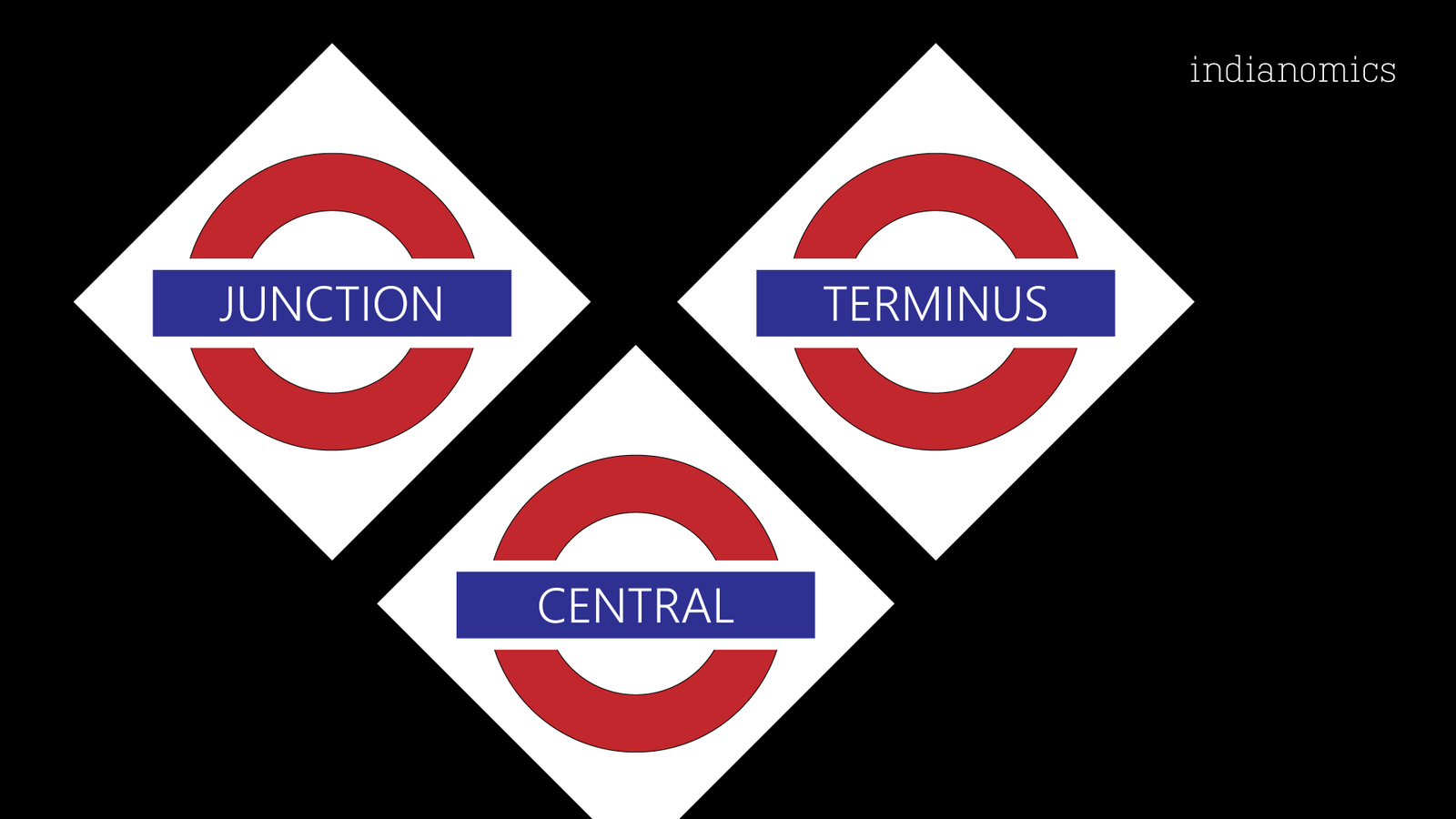
I had always wondered what is the difference between these three types of railway station. And it has almost always left me surprised. For example, a Junction can be a very small railway station. It is not even a major railway station either and very less population live the. If at all, the next major station should be given the Junction tag.
I know, I didn’t know why I was thinking like that. Today I know the difference and wanted to help you all know it all the same.
So what does a terminal or terminus mean?
A terminus / terminal is a station at the end of the railway line. Journey of each incoming railway tracks end, and the line stop (terminates, hence the name). So railway stations like Lokmanya Tilak Terminus is the station where a train track terminates or starts it line.
Railway station junction?
A junction is a railway station where two or more tracks going in different directions join. It can be a main line splitting into two, merging two lines into one or a branch line is created. You may be surprised to see some of the small railway stations being adjudged as junction – so next time you see one, you know why!
What about Central?
Any important or busiest railway station out of many stations in the city can be named Central. Perhaps in most cases, these railway stations are very big, and handle heavy movement of passenger and goods trains. These stations then earn the name central as it metaphorically represents the nerve center of the business and people movement in the area.
So, there you have it. If you like this post, perhaps you may like some of my others. Let me know what you think in the comment section below.
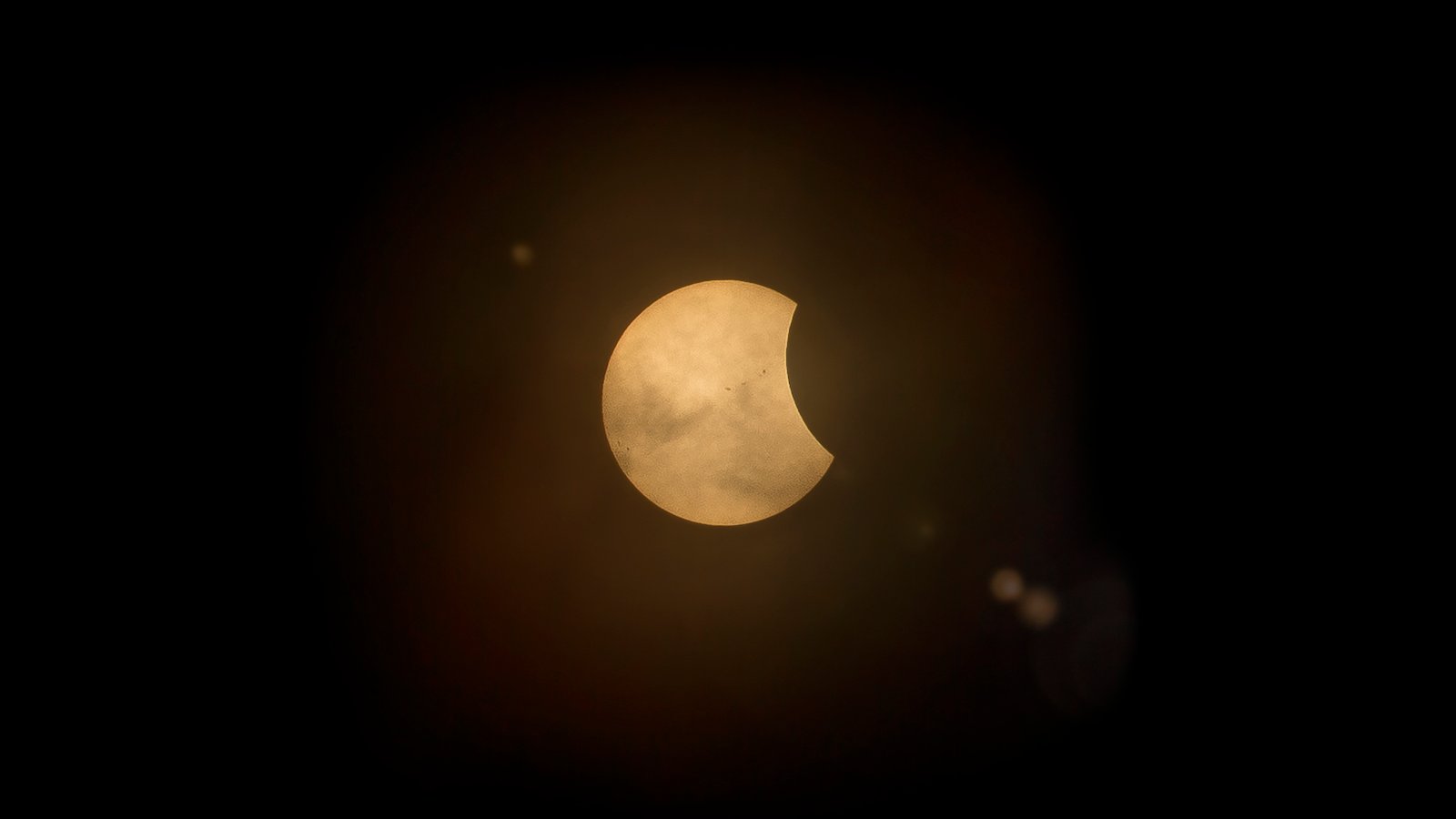
A partial lunar eclipse was visible over Mumbai on 7th of August, 2017 which I managed to catch on my camera. Though the quality was not that great, I still enjoyed my first time going live on my YouTube Channel, Indianomics.
I read in the news that the full moon will move into Earth’s shadow, which makes for a spectacle in the sky – which we call as Lunar Eclipse. These happen often (by celestial standards), however probably is one of most visible. In the video below, I have tied to shoot in negative so that the partial eclipse can been see, given the amount of clouds and dust in the sky surrounding Mumbai.
If you enjoyed the video, give a thumbs up and provide your feedback in the comments section below.
What is a Lunar Eclipse?
An extract from Wikipedia: A lunar eclipse occurs when the Moon passes directly behind the Earth into its umbra (shadow). This can occur only when the sun, Earth, and moon are aligned (in “syzygy”) exactly, or very closely so, with the Earth in the middle. Hence, a lunar eclipse can occur only the night of a full moon. The type and length of an eclipse depend upon the Moon’s location relative to its orbital nodes.
Tools used to shoot eclipse?
I used my iPhone to shoot the eclipse, live using the YouTube app. So far, I have not fully ventured into shooting serious videos and hence, have not invested in a great camera myself yet. I hope in future, and with money I get from advertisements (if at all I make that much), I will surely upgrade to a full fledged camera.
Streaming Networks?
I used my recently acquired Jio connection to stream live, which cost me about 450MB of my daily limits. Of course, I was live streaming via YouTube. Jio of late has really proved all its hype, especially after the free period ended. I am extremely happy with Jio so far, and I hope to get similar performance in future as well.